
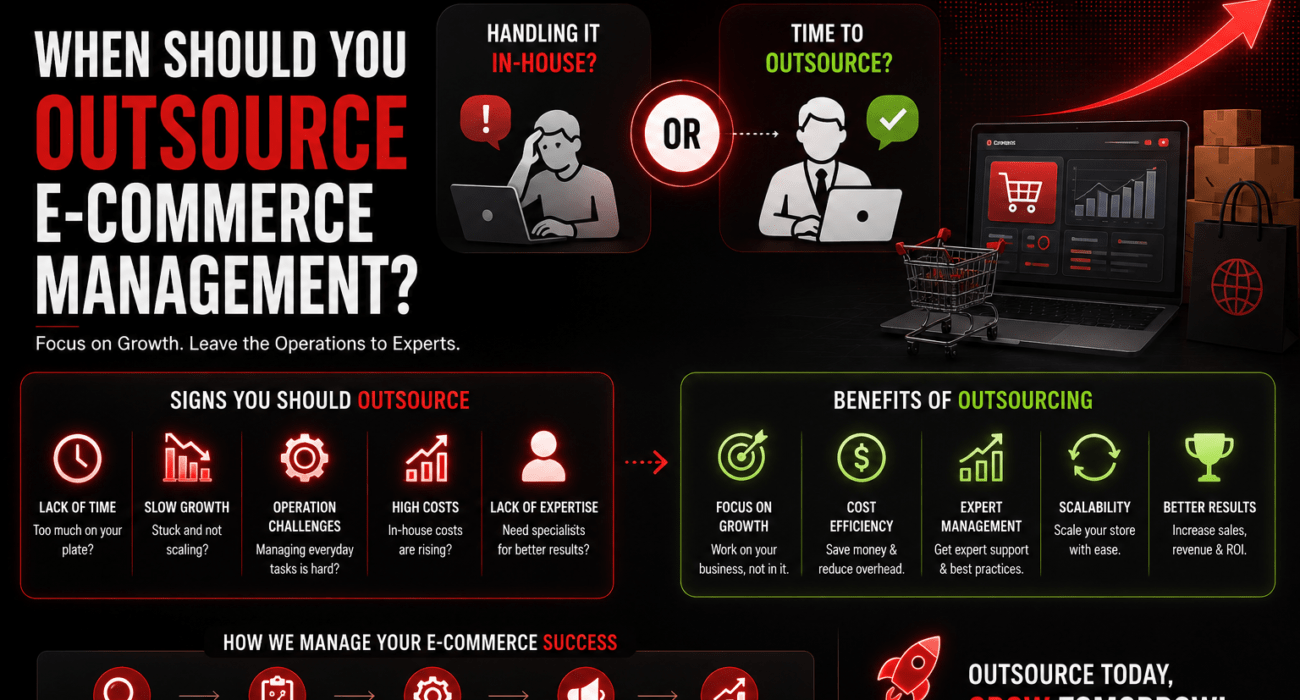
You should consider outsourcing e-commerce management when day-to-day operations start taking time away from growth, your team struggles to keep up with orders, inventory, customer service, or multiple sales channels, or hiring an in-house team no longer makes financial sense. Pinetrix provides e-commerce management and outsourcing services for U.S. businesses, helping brands streamline essential operations, access specialized support, and scale without adding every function to their internal team.
For growing brands operating across major U.S. commercial markets such as New York, Los Angeles, Chicago, Dallas, Austin, and Miami, managing these expanding workloads completely in-house can inflate fixed overhead and strain internal resources.
Key Takeaway: Direct Decision Summary
Direct Answer: Outsource e-commerce management when internal bandwidth limits core brand growth, operational errors degrade customer experience, or the fixed costs of recruiting and software infrastructure outweigh the flexible cost of an external operating partner.
Evaluating operational support for your online store? Explore how Pinetrix E-Commerce Management Services can help streamline your daily execution.
7 Signs You Should Outsource E-Commerce Operations
Recognizing when your internal team has reached its operational limit helps prevent fulfillment delays, negative reviews, and lost market share. Here are seven practical signs that your business may benefit from external e-commerce management support:
1. Daily Maintenance Is Hijacking Leadership Focus
When founders, COOs, or senior marketing leads spend hours manually uploading product listings, fixing broken catalog feeds, or resolving supplier delays, strategic growth stops. If routine tasks leave little time for product development or customer acquisition strategies, operational workload has become a bottleneck.
2. Customer Support Response Times Are Slipping
As order volume scales, customer inquiries naturally surge across live chat, email, and social channels. Slipping response times and unresolved tickets hurt retention and lower customer lifetime value. Implementing ecommerce customer service outsourcing through a dedicated team helps maintain consistent resolution speeds without expanding internal payroll.
3. Inventory and Storefront Listing Inaccuracies Are Rising
Running out of stock during peak promotional cycles or overselling across connected storefronts damages account health and product visibility on channels like Amazon, Walmart, and TikTok Shop. When manual processes fail to keep inventory aligned across channels, systematic operational management is required.
4. Multi-Channel Expansion Is Creating Operational Friction
Selling across multiple platforms requires adhering to distinct channel guidelines, formatting requirements, and compliance standards. Managing these nuances in-house without dedicated channel specialists often leads to listing suppressions, compliance delays, or lost Buy Box placements.
5. High Fixed Overhead Is Straining Operating Margins
Building an internal team for every specialized e-commerce function requires significant investment in salaries, health benefits, software tools, and ongoing training. Converting these fixed overhead expenses into a flexible operational model can protect operating margins during seasonal demand shifts.
6. Acquisition Costs Are Rising While Backend Execution Lags
Increasing performance marketing spend without optimizing store usability, product presentation, catalog structure, or customer support often leads to rising Customer Acquisition Costs (CAC) and lower conversion rates. Operational efficiency directly impacts marketing profitability.
7. Specialized Technical Expertise Is Missing
Tasks like implementing JSON-LD structured data schema, executing systematic Conversion Rate Optimization (CRO) tests, managing complex Product Information Management (PIM) software, and maintaining storefront integrations require technical skills that generalist internal teams rarely possess.
What E-Commerce Management Tasks Can You Outsource?
Modern ecommerce outsourcing services cover the full operational spectrum. Depending on your organization’s structure, you can outsource specific functional areas or delegate comprehensive management:
| E-Commerce Management Area | Key Services & Responsibilities |
|---|---|
| Storefront & Catalog Management | • Product listings & updates• Theme maintenance & CRO• Schema & search optimization |
| Marketplace & Account Health | • Seller Central management• Buy Box & listing health• Channel compliance auditing |
| Customer Care & Order Support | • Multichannel helpdesk support• Order tracking & returns care• Pre-sale chat & customer inquiries |
| Inventory & Process Management | • Multi-store inventory alignment• 3PL & warehouse oversight• Workflow documentation |
- Storefront & Catalog Management: Maintaining listing accuracy, updating banners, managing product metadata, and organizing category structures across platforms like Shopify Plus.
- Marketplace Operations: Managing Amazon Seller Central, resolving compliance flags, optimizing detail pages, and monitoring Buy Box health across third-party marketplaces.
- Customer Support & Order Care: Handling pre-sale inquiries, order status checks, returns authorization, and multi-channel ticket resolution through outsourced customer service.
- Inventory Coordination: Monitoring stock alignment between centralized warehouses, 3PL partners, and front-facing sales channels to minimize backorders and stockouts.
- Technical Optimization: Managing app integrations, improving store loading speeds, updating platform templates, and configuring structured data for traditional search engines and AI discovery systems.
Strategic Evaluation: Aligning Operational Capacity
If your internal team spends more time troubleshooting daily operational tasks than driving strategic growth, external operational support can help restore focus. Contact Pinetrix to discuss how our specialists can support your operations.
Task Delegation vs. Functional Outsourcing vs. Full E-Commerce Management
Understanding the distinction between task-level delegation, specialized functional outsourcing, and comprehensive e-commerce management helps ensure you select the operational model that matches your business needs:
1. Task-Level Outsourcing (Freelancers & VAs)
This model involves hiring freelancers or virtual assistants to complete discrete, temporary tasks such as batch uploading listing descriptions or editing product images. While cost-effective for isolated projects, task-level delegation requires heavy internal management, lacks strategic alignment, and rarely solves systemic operational bottlenecks.
2. Functional Outsourcing (Specialized Agencies & 3PLs)
Here, a business delegates an entire operational function to a specialized partner such as hiring a 3PL for warehousing and order fulfillment, or contracting an agency for paid media management. While this provides deep expertise within a single domain, coordinating multiple separate vendors can create communication silos and administrative overhead for your internal leadership.
3. Comprehensive E-Commerce Management
This approach coordinates storefront administration, marketplace management, outsourced customer care services, and technical operations under a single strategic framework. Working with an integrated partner establishes clear Service Level Agreements (SLAs), reduces vendor friction, and aligns daily execution with your business goals.
When Does E-Commerce Outsourcing Make Financial Sense?
Deciding whether to outsource ecommerce management requires analyzing internal staffing costs, software subscriptions, management oversight, and opportunity costs against the investment of an external partner.
1. In-House Payroll vs. Flexible Operational Models
Hiring dedicated internal staff for catalog management, marketplace operations, store maintenance, and customer care requires paying multiple competitive salaries along with benefits, payroll taxes, and onboarding expenses. For brands located in major U.S. commercial centers like Chicago, Dallas, or Los Angeles, these fixed labor costs add up quickly. Outsourcing transforms these fixed payroll commitments into a predictable operating model that scales with your operational requirements.
2. Software Infrastructure Overhead
Enterprise-grade e-commerce operations rely on specialized software tools including Product Information Management (PIM) platforms, helpdesk systems, analytics engines, and inventory middleware. External management partners leverage shared software infrastructure, helping clients avoid paying full standalone subscription costs for multiple specialized applications.
3. Evaluating Leadership Opportunity Cost
The most significant hidden cost of internal management is the time executive leadership spends on routine operational tasks. You can evaluate this using a straightforward formula:
Opportunity Cost = Hours Spent on Operational Tasks × Estimated Hourly Value of Leadership Time
If senior executives spend 15 to 20 hours per week resolving customer tickets, updating listing spreadsheets, or coordinating basic shipping inquiries, the business forfeits valuable strategic capacity that could be spent on product expansion, high-level marketing, or business development.
In-House vs. Outsourced E-Commerce Management
The table below outlines key practical differences between managing operations completely in-house, coordinating multiple functional vendors, and partnering with an integrated management provider like Pinetrix:
| Dimension | In-House Execution | Multiple Functional Vendors | Integrated Management (Pinetrix) |
| Cost Structure | High fixed payroll, benefits, and software fees | Multiple retainers + variable domain fees | Scalable, predictable operational investment |
| Speed to Expertise | Slower (requires recruiting & onboarding) | Fast within specific contracted domains | Rapid deployment across operational scope |
| Channel Integration | Depends entirely on internal team bandwidth | Can create silos between isolated partners | Coordinated execution across channels |
| Scalability During Peaks | Constrained by fixed internal staff count | Flexible within individual vendor contracts | Scalable operational support across touchpoints |
| Management Overhead | Requires direct, continuous supervision | Requires managing multiple external vendor relationships | Single point of contact & unified reporting |
| Operational SLAs | Direct oversight; capped by working hours | SLA coverage limited to single functional areas | Structured SLAs across support & operations |
What Are the Risks of E-Commerce Outsourcing? (And How to Mitigate Them)
While outsourcing provides operational agility, working with an external partner carries inherent risks. A transparent management partner will help you identify and address these risks proactively:
Risk 1: Loss of Direct Operational Control
- Mitigation: Establish explicit Service Level Agreements (SLAs) covering ticket resolution times, order processing windows, and listing accuracy metrics. Require shared management dashboards so your team maintains real-time visibility into operational performance.
Risk 2: Brand Voice Inconsistency in Customer Care
- Mitigation: Develop comprehensive brand voice guidelines, standard operating procedures (SOPs), and approval frameworks. Established providers offering outsource ecommerce customer service conduct structured onboarding programs to align agents with your brand voice before handling live inquiries.
Risk 3: Account Ownership & Data Security Concerns
- Mitigation: Retain primary administrative ownership of all storefronts, marketplace accounts, ad platforms, and domain access. Use enterprise access management tools (such as password managers and role-based permissions) rather than sharing master credentials.
Risk 4: Contract Lock-In and Hidden Fees
- Mitigation: Choose partners that offer clear, itemized scopes of work with flexible terms and transparent fee structures, avoiding ambiguous billing practices or long-term restrictive commitments.
How to Choose the Right E-Commerce Management Partner
Selecting an outsourced ecommerce solutions provider requires evaluating technical capabilities, industry experience, and operational alignment. Consider these essential criteria when vetting prospective partners:
- Platform & Channel Proficiency: Verify hands-on experience with your platform stack whether you use Shopify Plus, Amazon Seller Central, TikTok Shop, or specialized enterprise tools.
- Multi-Channel Compliance Expertise: Ensure the partner understands channel-specific operational rules, such as Amazon account health metrics, retail routing guidelines, and catalog formatting requirements.
- Comprehensive Support Coverage: For customer-facing functions, confirm that the provider offers support across email, live chat, and social channels tailored to your target audience’s time zones.
- Security & Access Protocols: Confirm that the partner follows strict data security practices, role-based access controls, and non-disclosure standards to safeguard customer data and proprietary information.
- Transparent SLAs & Reporting Cadence: Request clear performance benchmarks and regular operational reporting so you can measure execution quality against your business objectives.
Step-by-Step Transition Strategy: Moving to Outsourced Operations
Transitioning your daily store operations to an external partner requires a systematic plan to ensure continuous customer service and prevent operational gaps:
| Phase | What to Do | Key Focus |
|---|---|---|
| Phase 1: Internal Operational Audit | Map current workflows and identify repetitive manual tasks, platform-management gaps, and customer-support bottlenecks. | Find inefficiencies and outsourcing opportunities |
| Phase 2: Define Scope & KPIs | Decide which functions to outsource first, such as catalog management or customer care, and establish measurable KPIs. | Set clear responsibilities and performance targets |
| Phase 3: Secure Access & Asset Transfer | Provide secure, role-based access to storefronts, marketplace accounts, and support platforms. | Protect accounts, data, and business assets |
| Phase 4: Phased Onboarding | Start by transitioning one operational area, such as off-peak customer ticket management, before expanding to broader operations. | Reduce disruption and validate the process |
| Phase 5: Ongoing Reviews | Conduct weekly or monthly reviews to monitor SLAs, operational metrics, product launches, and promotional activities. | Maintain performance and strategic alignment |
E-Commerce Outsourcing Decision Checklist
Use this practical decision matrix to evaluate whether your business is ready for external e-commerce management support:
- Is senior leadership spending more than 10 to 15 hours per week on routine operational administration?
- Are customer inquiry backlogs or response delays causing negative reviews or lost sales?
- Are catalog inaccuracies, out-of-stock events, or listing suppressions occurring on channels like Amazon or Shopify?
- Is internal hiring, training, and software overhead placing pressure on operating margins?
- Are you expanding across major U.S. regional markets (such as Miami, Austin, New York, or Los Angeles) without adequate internal execution capacity?
- Does your business lack in-house technical support for ongoing store maintenance, app updates, and schema implementations?
If several of these challenges apply to your business, evaluating external operational management could help improve efficiency and free your team to focus on strategic growth.
Frequently Asked Questions
When should a business consider outsourcing e-commerce management?
A business should consider outsourcing when daily operational maintenance, customer support volume, multi-channel management, or technical maintenance requires more time than internal staff can sustainably handle. Outsourcing is particularly effective when internal bandwidth limits core growth activities like marketing and product development.
What is the difference between a 3PL and an e-commerce management partner?
A 3PL (Third-Party Logistics) provider focuses strictly on physical supply chain tasks: warehousing, inventory storage, picking, packing, and shipping orders. An e-commerce management provider manages digital store operations including storefront maintenance, marketplace account health, product catalog updates, customer support coordination, and technical optimizations.
Will outsourcing e-commerce management cause me to lose control of my brand?
No. High-level business decisions such as brand strategy, product innovation, pricing, and marketing direction—remain under your leadership team’s direct control. An external partner operates within your established brand guidelines, standard operating procedures, and SLAs to execute daily operational tasks.
What e-commerce tasks are easiest to outsource first?
Customer support ticketing, catalog management, product listing updates, and marketplace account monitoring are typically the easiest and most effective tasks to outsource first. Delegating these functional areas provides immediate relief to internal teams without disrupting core business strategy.
Can growing U.S. businesses benefit from remote operational management?
Yes. E-commerce businesses operating across key commercial centers including Dallas, Austin, New York, and Chicago—regularly utilize outsourced management to scale support coverage and maintain store health while controlling fixed payroll expenses.
Streamline Your E-Commerce Operations with Pinetrix
Managing a growing online retail business should not mean getting bogged down in daily administrative troubleshooting. Partnering with an experienced operational team allows you to delegate catalog maintenance, marketplace management, customer support, and technical updates so you can keep your focus on long-term strategy and revenue expansion.
At Pinetrix, we help businesses across the United States optimize their online store execution. Whether you need targeted support for customer care and catalog updates or broader multi-channel management, our team delivers the operational discipline required to keep your business running smoothly.
Ready to elevate your operational efficiency?
- Explore our full range of Pinetrix E-Commerce Management Services .
- Contact Pinetrix today to discuss your operational needs with an e-commerce specialist.