
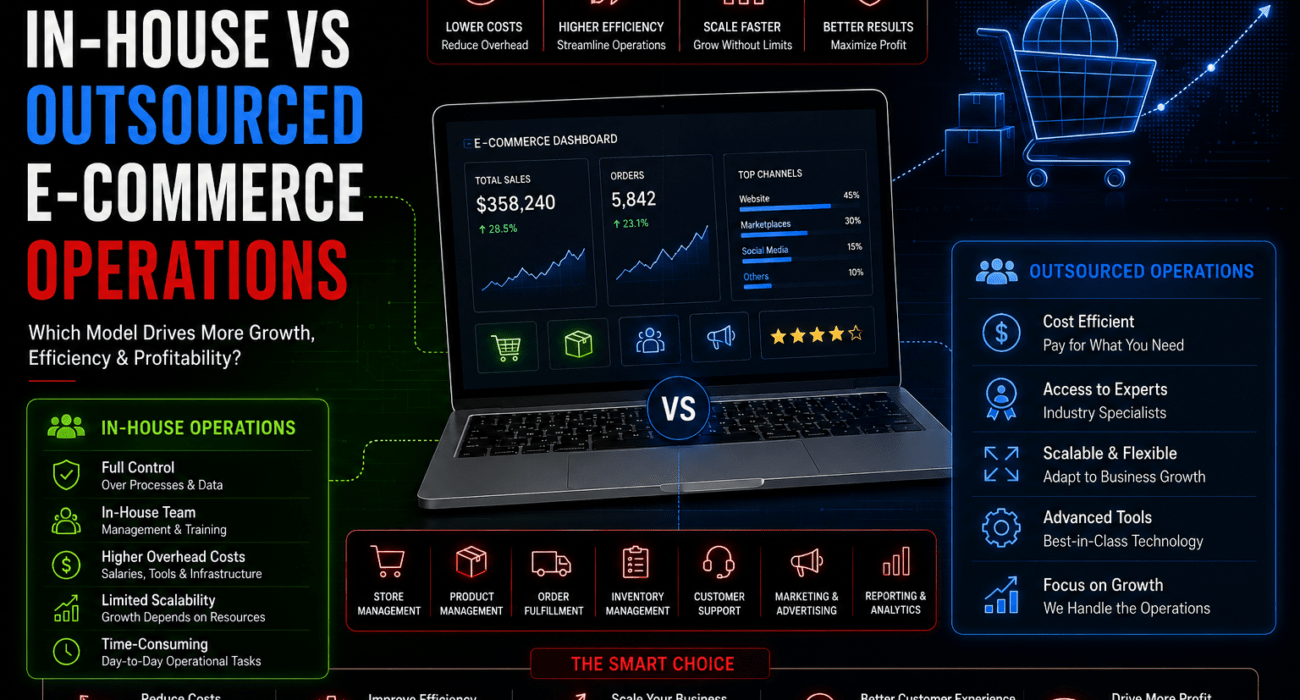
Are high operational overheads, inventory sync errors, and technical debt draining your bottom line? Stop piecing together fragmented solutions. Pinetrix delivers end-to-end e-commerce web development, custom API integrations, and scalable store infrastructure across the entire United States. Whether you are scaling a fast-growing DTC brand in Los Angeles or optimizing high-volume digital storefronts in New York, Pinetrix equips your business with the custom web engineering needed to cut costs, scale effortlessly, and dominate search rankings. Contact Pinetrix Today for a complete e-commerce architecture audit.
Executive Summary: In-House vs. Outsourced Quick Decision Matrix
Choosing between in-house and outsourced e-commerce operations hinges on CAPEX vs. OPEX flexibility, technical complexity, and order velocity.
| Operational Pillar | In-House Operations | Outsourced Operations | The Pinetrix Hybrid Solution |
| Storefront & Web Dev | High fixed labor costs; slow feature deployment | Dependency on external agencies | Custom scalable architecture with 24/7 dedicated support |
| Fulfillment & Logistics | High CAPEX (warehouses, staff); fixed overhead | Variable OPEX (3PLs); risk of hidden storage fees | Custom WMS/ERP integrations to streamline 3PL workflows |
| Customer Experience | Higher brand alignment; restricted shift coverage | Scalable CSAT support; variable quality control | Automated AI triage + direct tier-2 escalations |
| Payment & Taxes | Direct merchant accounts; complex liability | Merchant of Record (MoR) handles global compliance | Custom checkout flows + automated cross-border tax compliance |
What are E-Commerce Operations? The 4 Core Pillars
Managing modern e-commerce growth requires orchestrating four distinct infrastructure pillars:
- Storefront Development & Tech Stack Maintenance: Custom storefront engineering on Shopify Plus, WooCommerce, or Adobe Commerce (Magento), headless CMS architectures, database performance optimization, and custom API maintenance.
- Warehousing, Inventory & 3PL Fulfillment: Real-time Inventory Management Systems (IMS), Order Management Systems (OMS), and Warehouse Management System (WMS) integration like ShipStation and NetSuite.
- Customer Experience & Support: Live chat automation, omnichannel ticketing (Zendesk, Gorgias), and maintaining high Customer Satisfaction (CSAT) and First Contact Resolution (FCR) rates.
- Financial, Tax & Merchant Operations: Merchant of Record (MoR) frameworks, payment gateway optimization (Stripe, PayPal), chargeback prevention, and local sales tax compliance (Avalara).
In-House E-Commerce Operations: Deep Dive
Handling operations internally offers complete control, but requires massive capital investments and continuous oversight.
Advantages
- Complete Brand & Data Control: Direct oversight of the user experience (UX), customer data, and brand identity without third-party interference.
- Agile Customization: Ability to roll out immediate promotional changes and custom landing pages without waiting on external agency schedules.
Disadvantages
- Heavy Capital Expenditure (CAPEX): High fixed overhead including engineering salaries, server maintenance, local warehousing, and physical infrastructure.
- Scaling Bottlenecks: Technical debt builds up quickly if internal teams lack specialized e-commerce engineering experience during peak traffic spikes like Black Friday/Cyber Monday (BFCM).
Outsourced E-Commerce Operations: Deep Dive
Outsourcing shifts costs into operational expenses (OPEX), giving growing businesses flexibility to scale up or down based on market demand.
Advantages
- Variable OPEX Cost Structure: Pay only for the computing power, developer hours, or fulfillment bandwidth you consume during a given month.
- Instant Infrastructure Access: Rapid access to enterprise-level logistics, global payment gateways, and advanced technical stacks without building them from scratch.
Disadvantages
- Hidden Costs & SLA Risks: Misaligned Service Level Agreements (SLAs) can lead to unexpected storage surcharges, API rate-limiting penalties, and delayed tickets.
- Loss of Direct Oversight: Reliance on third-party code standards or external fulfillment workflows that may compromise quality control.
The Hybrid Model: The Modern E-Commerce Standard
Leading online brands rarely use a purely binary approach. Instead, they rely on a Hybrid Model:
| Operational Tier | Responsible Party | Operational Scope |
| Core Brand Operations | In-House Team | Brand Strategy, Product Innovation, Marketing Campaigns |
| Managed Tech Infrastructure | Pinetrix | Custom Engineering, Headless APIs, ERP Integrations, Site Speed |
| Physical Logistics & CS | Specialized Partners | 3PL Warehousing, Freight Shipping, Tier-1 Customer Support |
By leveraging Pinetrix for backend tech infrastructure, web architecture, and platform integrations, you keep strategic brand vision in-house while delegating heavy technical execution and logistics to specialized partners.
Strategic E-Commerce Web Engineering Across Key US Business Hubs
Pinetrix delivers e-commerce web development, ERP integrations, and store optimization services across the entire United States, providing tailored technical support to high-demand regional markets:
- New York, NY: Enterprise-grade headless architecture, high-concurrency checkout optimization, and sub-second page loads for competitive fashion and DTC brands searching for e-commerce web development services in New York City.
- Los Angeles, CA: Custom Shopify Plus and WooCommerce setups built to handle flash sales, high traffic spikes, and multi-channel inventory syncing for brands looking for a top e-commerce development agency in Los Angeles.
- Chicago, IL: Industrial B2B e-commerce platform developments featuring custom portal builds, complex ERP integrations (SAP, Oracle), and bulk ordering logic for businesses seeking B2B e-commerce website development in Chicago.
- Dallas, TX: Advanced 3PL warehouse management system (WMS) API setups, custom automated shipping calculators, and logistics portal integrations for companies needing custom e-commerce integration services in Dallas.
- Miami, FL: Cross-border e-commerce web setups with multi-currency, multi-language localized checkouts, and integrated international tax software for businesses looking for cross-border e-commerce developers in Miami.
- Atlanta, GA: Omnichannel web integrations connecting physical point-of-sale (POS) systems with digital storefronts for unified inventory management for retailers searching for omnichannel e-commerce solutions in Atlanta.
Total Cost of Ownership (TCO) & Decision Framework
To calculate whether to build in-house or outsource your technology infrastructure, evaluate the total cost of ownership:
TCO = Initial CAPEX + Monthly Recurring OPEX + Integration Fees + Maintenance & Downtime Risk
When your internal developer salaries, platform maintenance fees, and technical bug fixes exceed the cost of a specialized managed engineering partner, migrating to Pinetrix lowers your operational costs while unlocking enterprise speed and stability.
Why Partnering with Pinetrix Outperforms the Competition
Generic agencies force you into cookie-cutter templates that slow down your website and lock you into expensive monthly retainers. Pinetrix engineers custom e-commerce web applications tailored to your exact operational workflows:
- Speed & Performance: Clean, modular code that passes Google Core Web Vitals and maximizes conversion rates across all mobile devices.
- Seamless API Integrations: Custom middleware connecting your store to ERPs, CRMs, 3PLs, and payment gateways without data loss.
- End-to-End US Coverage: Broad technical expertise serving brands nationwide with reliable, scalable web solutions.
Ready to Scale Your E-Commerce Store?
Stop letting outdated web architecture and high overhead hold back your business growth. Transform your e-commerce operations with customized, high-converting digital infrastructure built by experts.
Contact Pinetrix Today to book a consultation, or visit our E-Commerce Services Page to explore how we can optimize your online storefront.
Frequently Asked Questions
When should an e-commerce brand switch from in-house to 3PL fulfillment?
Brands typically switch to a 3PL when order volume exceeds 1,000–1,500 shipments per month, or when warehouse overhead and shipping delays start impacting customer satisfaction.
Can Pinetrix integrate custom ERP systems with Shopify or WooCommerce?
Yes, Pinetrix specializes in custom API middleware engineering to connect platforms like NetSuite, SAP, and Salesforce directly to your digital storefront for real-time inventory and order processing.
Does Pinetrix provide e-commerce web development services nationwide in the US?
Yes, Pinetrix works with clients across the entire United States, providing specialized web development, platform optimization, and maintenance services tailored to regional business needs.