
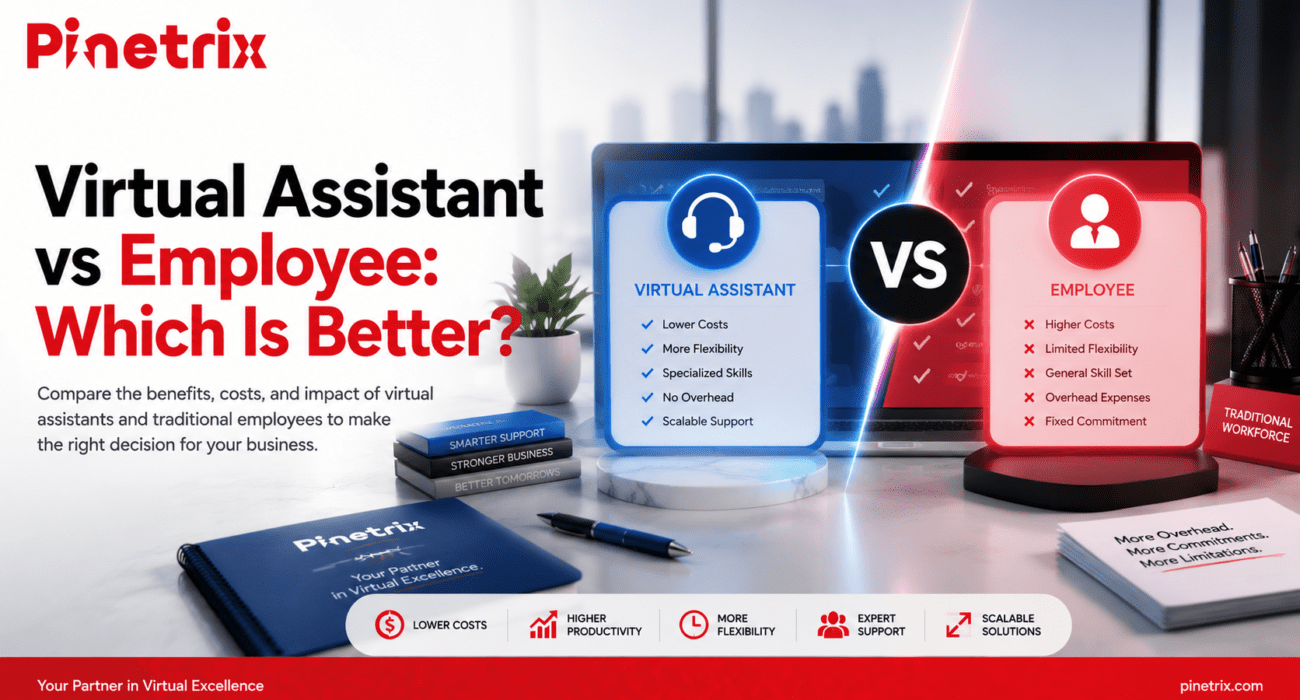
As businesses grow, so do their operational demands. Managing customer inquiries, administrative work, scheduling, lead generation, and daily business operations often requires additional support. At this stage, many business owners face an important question: Should you hire a virtual assistant or recruit a full-time employee?
The answer depends on your business goals, workload, budget, and the type of support you need. While hiring an in-house employee offers direct oversight and long-term team integration, virtual assistants provide flexible, cost-effective business support without many of the expenses associated with traditional hiring.
Both options have their advantages, and understanding the differences can help you make a more informed decision that supports your business today while preparing for future growth.
In this guide, we’ll compare virtual assistants and in-house employees across key factors such as cost, flexibility, productivity, scalability, communication, and business value, helping you determine which solution is the better fit for your organization.
Virtual Assistant vs Employee at a Glance
Both virtual assistants and in-house employees can contribute to business success, but they serve different operational needs.
| Virtual Assistant | In-House Employee |
| Works remotely | Works on-site or in-office |
| Flexible workload | Fixed working schedule |
| Lower operational costs | Higher employment expenses |
| Faster onboarding | Longer hiring process |
| Easy to scale support | Expansion often requires additional hiring |
| Ideal for administrative and operational tasks | Suitable for long-term internal responsibilities |
Choosing the right option depends on your business priorities rather than assuming one solution is always better than the other.
Why Businesses Compare Virtual Assistants and Employees
Business owners want to maximize productivity while managing operational costs effectively. Hiring additional support is often necessary, but not every task requires a full-time employee.
Many repetitive responsibilities including email management, appointment scheduling, customer support, CRM updates, online research, lead generation, and back-office operations can often be handled efficiently by a professional virtual assistant. Meanwhile, roles that require daily on-site collaboration, hands-on responsibilities, or direct supervision may be better suited to in-house employees.
Understanding the strengths of each option helps businesses allocate resources more effectively and build teams that support long-term growth.
When a Virtual Assistant Is the Better Choice
Virtual assistants are an excellent solution for businesses looking to improve efficiency without significantly increasing operational expenses. They provide professional remote support and can often begin contributing more quickly than traditional hires.
A virtual assistant may be the better choice if your business needs:
- Administrative support
- Email and calendar management
- Customer support
- Lead generation and CRM management
- Data entry and documentation
- E-commerce operations
- Online research
- Social media assistance
- Appointment scheduling
- Back-office support
Because virtual assistants work remotely, businesses can access specialized expertise while maintaining flexibility as workloads change.
Expert Tip: If repetitive operational tasks are preventing your team from focusing on growth, hiring a virtual assistant is often a practical first step before expanding your in-house workforce.
When an In-House Employee Is the Better Choice
While virtual assistants offer flexibility and cost savings, there are situations where hiring an in-house employee is the better long-term solution. Some roles require regular on-site collaboration, direct supervision, or responsibilities that cannot be performed remotely.
An in-house employee may be the right choice if your business requires:
- Daily office-based responsibilities
- Hands-on operational or technical work
- Frequent face-to-face collaboration
- Long-term leadership or management roles
- Department-specific expertise that requires constant internal coordination
- Direct supervision of teams or business operations
Employees often become deeply integrated into company culture and internal processes, making them valuable for positions that require ongoing collaboration, strategic decision-making, and long-term organizational development.
Virtual Assistant vs Employee: Key Differences
Although both virtual assistants and in-house employees contribute to business success, they differ significantly in terms of flexibility, costs, hiring process, and scalability.
| Factor | Virtual Assistant | In-House Employee |
| Work Location | Remote | Office-based or on-site |
| Hiring Process | Faster onboarding | Longer recruitment process |
| Operational Costs | Lower overhead costs | Higher costs for salaries, office space, equipment, and employee benefits |
| Flexibility | Support can be scaled up or down based on workload | Fixed schedules and defined responsibilities |
| Specialized Expertise | Access to professionals with diverse business skills | Typically hired for a specific role or department |
| Business Scalability | Easy to expand support as business grows | Growth often requires additional recruitment |
| Management | Requires clear communication and documented workflows | Direct supervision and in-person collaboration |
Both approaches have advantages. The best choice depends on the nature of the work, your budget, and your long-term business objectives.
Cost Comparison
One of the biggest differences between a virtual assistant and an in-house employee is the overall cost of hiring and maintaining support.
Hiring an employee typically involves expenses beyond salary, including recruitment, onboarding, office space, equipment, software licenses, training, employee benefits, and ongoing operational costs.
Virtual assistant services, on the other hand, often allow businesses to access professional support without many of these additional overhead expenses. This makes them an attractive option for startups, small businesses, and organizations looking to optimize operational efficiency.
While cost is an important consideration, it should not be the only deciding factor. Businesses should evaluate the overall value, quality of support, and long-term impact on productivity rather than focusing solely on immediate savings.
Business Insight: Many growing businesses use virtual assistant services as part of their broader business process outsourcing (BPO) strategy, allowing them to streamline operations, reduce administrative workload, and scale more efficiently while keeping internal teams focused on strategic initiatives.
Flexibility and Scalability
Business needs rarely remain the same for long. Seasonal demand, business expansion, and changing customer expectations all require organizations to adapt quickly.
Virtual assistants provide a high level of flexibility because businesses can adjust support based on workload without going through lengthy recruitment processes. Whether you need help for a few hours each week, project-based assistance, or ongoing operational support, virtual assistant services can often scale alongside your business.
In contrast, expanding an in-house team generally requires additional hiring, onboarding, training, and long-term employment commitments.
For businesses experiencing rapid growth or fluctuating workloads, flexibility can be just as valuable as cost savings.
Expert Tip: Many successful businesses adopt a hybrid approach by keeping core strategic roles in-house while outsourcing administrative, customer support, lead generation, and back-office tasks to professional virtual assistants. This approach combines operational efficiency with long-term organizational stability.
Productivity and Collaboration
Productivity isn’t determined solely by where someone works—it’s influenced by how effectively tasks are managed, communicated, and completed. Both virtual assistants and in-house employees can improve business performance, but they contribute in different ways.
Virtual assistants increase productivity by handling repetitive and time-consuming operational tasks, allowing business owners and internal teams to focus on strategic planning, customer relationships, and business growth. Since many virtual assistants specialize in specific business functions, they can often integrate into existing workflows with minimal disruption.
In-house employees, on the other hand, are often better suited for roles requiring continuous collaboration, department leadership, or hands-on responsibilities. Their daily presence within the organization can support long-term projects, team management, and company culture.
Ultimately, the most productive solution depends on the type of work your business needs to accomplish.
Which Option Is Best for Your Business?
There isn’t a one-size-fits-all answer. The right choice depends on your operational requirements, budget, growth plans, and the type of support your business needs.
A virtual assistant is often the better choice if you:
- Want to reduce administrative workload.
- Need flexible business support that can scale over time.
- Want to lower operational costs.
- Require expertise in customer support, lead generation, CRM management, or e-commerce operations.
- Need help with recurring tasks without hiring another full-time employee.
An in-house employee may be the better option if you:
- Require daily on-site collaboration.
- Need someone to manage internal teams or departments.
- Have responsibilities that require physical presence.
- Are hiring for long-term leadership or highly specialized internal roles.
- Want a permanent employee fully integrated into company culture.
Many growing businesses find that a combination of both approaches provides the greatest value. Core leadership and strategic roles remain in-house, while repetitive administrative and operational tasks are outsourced to professional virtual assistants. This hybrid model improves efficiency while allowing businesses to remain flexible as they grow.
Why Businesses Choose Professional Virtual Assistant Services
While individual freelancers may be suitable for specific projects, many organizations prefer working with professional virtual assistant service providers that offer structured processes, trained professionals, quality assurance, and the ability to scale support as business needs evolve.
Professional providers typically offer:
- Experienced virtual assistants with specialized business expertise.
- Consistent service quality and standardized workflows.
- Flexible support that grows with your business.
- Business continuity through dedicated teams and structured processes.
- Secure systems for handling confidential business information.
- Access to support across multiple business functions.
At Pinetrix, we provide tailored virtual assistant services that help businesses improve productivity, streamline operations, and reduce administrative workload. Whether you need support with customer service, lead generation, back-office operations, administrative tasks, or e-commerce management, our experienced professionals become an extension of your team, helping your business operate more efficiently.
Conclusion
Choosing between a virtual assistant and an in-house employee isn’t about deciding which option is universally better, it’s about selecting the solution that best aligns with your business goals, operational needs, and future growth plans.
Virtual assistants offer flexibility, lower operational costs, and access to specialized expertise, making them an excellent choice for businesses looking to outsource administrative and operational responsibilities. In-house employees, meanwhile, provide dedicated on-site support and are better suited for roles requiring continuous collaboration, leadership, or hands-on involvement.
For many businesses, the most effective approach is a balanced one. Combining an internal team with professional virtual assistant services allows organizations to improve efficiency, optimize resources, and scale more confidently.
If you’re looking for reliable virtual assistant services, Pinetrix provides flexible business support tailored to your unique operational needs. Our experienced professionals help businesses streamline workflows, enhance productivity, and focus on sustainable growth.
Visit us to learn how our solutions can help your business grow!
Frequently Asked Questions
Is a virtual assistant better than an employee?
Neither option is inherently better. A virtual assistant is ideal for remote administrative and operational support, while an in-house employee is better suited for roles that require on-site collaboration, direct supervision, or long-term leadership responsibilities.
Is hiring a virtual assistant more cost-effective?
In many cases, yes. Virtual assistant services can help businesses reduce expenses related to recruitment, office space, equipment, training, and employee benefits while providing flexible support based on business needs.
Can a virtual assistant replace a full-time employee?
A virtual assistant can manage many administrative, customer support, lead generation, CRM, and back-office tasks. However, roles requiring physical presence, hands-on work, or direct team management are generally better suited to in-house employees.
Which businesses benefit most from virtual assistant services?
Startups, small businesses, e-commerce companies, professional service firms, healthcare organizations, real estate agencies, and growing enterprises often benefit from virtual assistant services because they provide flexible operational support without the overhead of expanding an internal workforce.
Can businesses use both virtual assistants and employees?
Yes. Many successful businesses use a hybrid model, keeping strategic and leadership roles in-house while outsourcing repetitive administrative, customer support, lead generation, and back-office tasks to professional virtual assistants. This approach improves operational efficiency while supporting long-term business growth.