
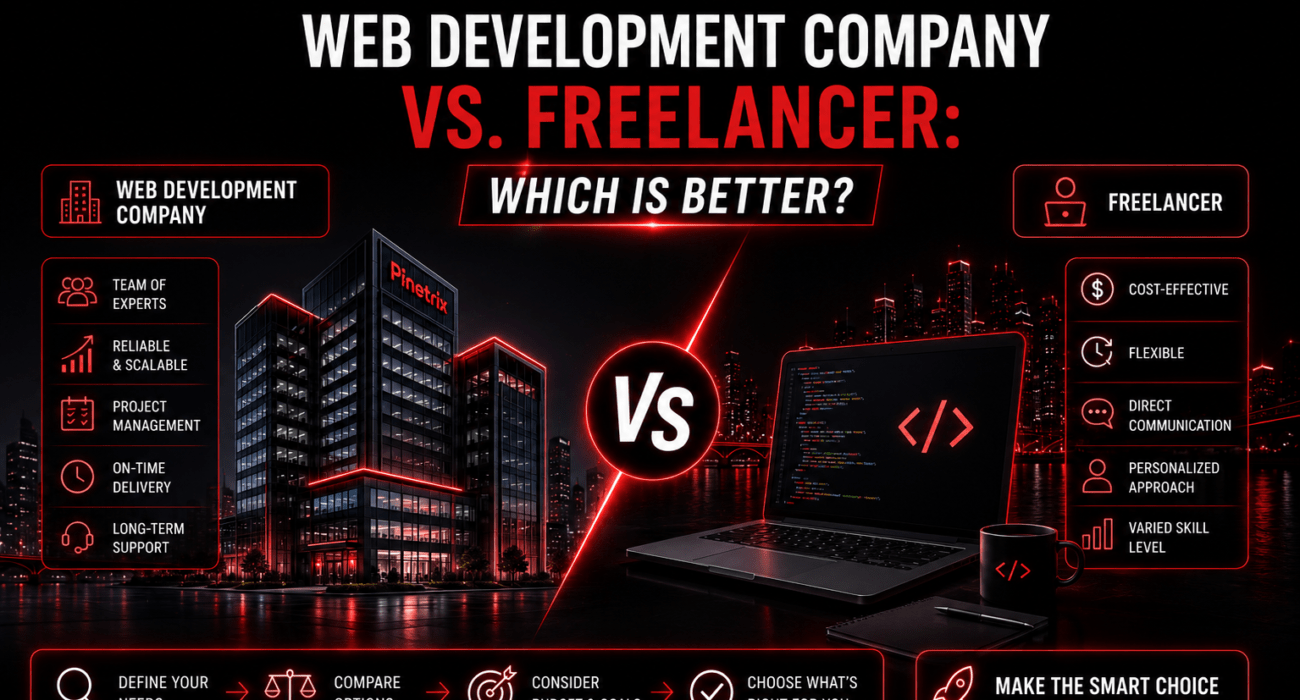
If you’re trying to decide between a freelance web developer and a web development company, the biggest question isn’t simply, “Who charges less?” It’s who can reliably deliver what your business actually needs. A freelancer can be a smart choice for a small, fixed-scope website, while a web development company is often the better fit for custom web development, complex integrations, eCommerce, web applications, and ongoing support. Pinetrix provides web development services for businesses that need more than a one-time website buildco mbining development, quality assurance, and technical support to create solutions that can grow with the business.
Freelancer vs. Web Development Company: Quick Answer
| Factor | Freelancer | Web Development Company |
| Upfront cost | Usually lower | Usually higher |
| Simple website | Excellent fit | May be more than needed |
| Custom web application | Depends on expertise | Better suited |
| Multiple specialists | Limited to the individual | Multiple specialists available |
| Quality assurance | May be self-managed | Can be handled by a dedicated QA process |
| Project management | Often client-managed | May be handled by a project team |
| Scalability | Depends on individual capacity | Easier to scale resources |
| Post-launch support | Varies by developer | Structured support may be available |
| Single-person dependency | Higher | Lower |
| Best for | Small, defined projects | Complex, long-term projects |
The short answer: Hire a freelancer when you have a relatively simple project, a clear scope, and a tight budget. Consider a web development company when your website is business-critical, technically complex, requires multiple skill sets, or needs ongoing development and support.
At a Glance: When Should You Hire Which?
The right choice depends on the complexity, risk, budget, and long-term role of your website.
Choose a Freelancer If…
A freelance web developer may be the better option when you need:
- A simple 3–5 page business website
- A basic WordPress website
- A landing page
- Small website updates or bug fixes
- A narrowly defined development task
- A project with a fixed scope and limited budget
- Direct communication with one developer
For example, an Austin business that needs a straightforward informational website with standard functionality may not need a full development team.
Freelancers can also provide flexibility and direct communication because you’re working with one person rather than coordinating through an organization.
Choose a Web Development Company If…
A web development agency in Austin may make more sense when your project requires broader capabilities, such as:
- Custom website development
- Web application development
- eCommerce web development
- API integrations
- Custom databases or backend systems
- Advanced front-end and back-end development
- UI/UX design
- Quality assurance and testing
- Ongoing website maintenance
- Post-launch technical support
- A scalable SaaS or business platform
The advantage isn’t simply having “more developers.” It’s having access to different roles when the project requires them, such as a front-end developer, back-end developer, UI/UX designer, QA tester, project manager, or DevOps engineer.
For businesses searching for custom web development in Austin, this broader capability can matter more than the initial quote.
What Are You Actually Hiring?
There’s a fundamental difference between hiring one developer and hiring a development team.
With a freelancer, you’re primarily hiring one person’s expertise and availability.
With a company, you’re potentially buying access to a complete development process: planning, design, development, testing, deployment, maintenance, and technical support.
Neither model is automatically better.
The question is whether your project needs one person’s expertise or a coordinated team of specialists.
For a simple website, a freelancer may be exactly what you need.
For a revenue-generating eCommerce store, customer portal, SaaS platform, or custom web application, the consequences of choosing the wrong development model can be much greater.
That is why the cheapest quote should not be the only factor in your decision.
Web Development Company vs. Freelancer: The Real Cost
When comparing a freelancer with a web development company, it’s easy to focus on hourly rates.
That’s often the wrong comparison.
A freelancer may offer a lower development quote because you’re working directly with one person. But depending on the project, you may also be responsible for coordinating requirements, reviewing deliverables, testing functionality, managing deadlines, and finding additional specialists when something falls outside the developer’s expertise.
The Hidden Cost of Managing a Freelancer
Consider what happens behind the scenes:
Freelancer model
Developer → You manage the project → You review work → You test → You request revisions → You coordinate additional help
Company model
Project planning → Development team → QA/testing → Review → Deployment → Ongoing support
A company doesn’t automatically cost less, and not every agency includes the same services. But a structured web development service may reduce the amount of technical coordination you have to handle yourself.
So instead of asking:
“Who has the lowest hourly rate?”
ask:
“What will this project actually cost me in money, time, management, and potential rework?”
That is a much better way to compare a freelance web developer vs. web development agency.
The Single Point of Failure Problem
One of the biggest risks of relying on a single developer is dependency.
Imagine your freelancer is responsible for your website’s code, hosting configuration, integrations, deployment process, and technical knowledge.
Then something changes.
They become unavailable.
A critical bug appears.
You need a new feature outside their expertise.
You can’t access the repository.
Nobody else understands the codebase.
Suddenly, a small project can become a major operational problem.
This is often called a single point of failure.
A development company can reduce this risk through team-based processes, shared repositories, documentation, code reviews, and access controls. However, you should always verify what a provider actually offers rather than assuming every agency follows the same process.
Before Hiring, Ask About:
- Git or GitHub/GitLab version control
- Source-code ownership
- Documentation
- Hosting and domain access
- Backup procedures
- Deployment access
- Code review
- Testing and QA
- Post-launch support
- Who handles the project if the primary developer becomes unavailable
These details may seem technical, but they can determine how easy or difficult, it is to maintain your website later.
Code Quality, Documentation & IP Ownership
A website isn’t finished simply because it is live.
If you’re investing in custom web development, you also need to think about what happens six months or two years after launch.
Before signing a contract, clarify:
Who owns the source code?
Your agreement should clearly address intellectual property (IP) ownership, source-code access, hosting credentials, domain access, third-party software, and any licensing restrictions.
For more complex projects, ask whether the development process includes:
- Version control
- Code reviews
- Testing procedures
- Staging environments
- Technical documentation
- Secure deployment
- Regular backups
A properly documented project is easier to maintain, transfer, improve, and scale.
This matters even more for web applications, SaaS platforms, eCommerce systems, and API integrations, where future development may depend heavily on the quality and structure of the original code.
Where Should You Hire a Freelancer?
If you’ve decided that a freelancer is the right fit, the next question is where to find one.
Platforms such as Upwork and Fiverr provide access to large freelancer pools, while vetted developer networks such as Toptal and Lemon.io use different screening and matching approaches.
These platforms can be useful, but the platform itself doesn’t eliminate the need for due diligence.
Before hiring, review:
- Relevant project experience
- Technical skills
- Client reviews
- Portfolio quality
- Communication habits
- Availability
- Development process
- Ownership and handover terms
- Post-launch support
For example, don’t hire a freelancer simply because they list “full-stack developer” on their profile. Ask for evidence that they’ve built something similar to what you’re planning.
When a Freelancer Stops Being the Best Option
A freelancer can be perfectly capable of building sophisticated websites. The issue isn’t necessarily skill; it’s capacity and coverage.
Your project may start as:
“We just need a website.”
Then requirements grow:
- Custom design
- User accounts
- Payment processing
- CRM integration
- API connections
- Advanced analytics
- Performance optimization
- Security improvements
- Ongoing feature development
At that point, you’re no longer buying a simple website.
You’re building a digital product that may require several different skill sets.
That’s where a custom web development company can become a more practical option.
The goal isn’t to choose a company simply because it sounds more professional. It’s to choose the model that gives your business the capabilities it actually needs.
Web Development Company vs. Freelancer: Which One Costs More?
There is no universal price difference between a freelancer and a web development company because the final cost depends on the project’s scope, technology, functionality, design, integrations, and support requirements.
In general:
Freelancer: Lower overhead and often a lower initial project cost.
Web development company: Higher investment may provide broader expertise, project management, QA, technical coordination, and ongoing support.
But comparing only the initial quote can be misleading.
A $4,000 freelancer project isn’t automatically cheaper than a $7,000 company project if the first option requires significant management, additional contractors, rework, or future fixes.
Think About Total Cost of Ownership
Instead of looking only at the development invoice, consider:
Total Cost of Ownership = Development + Management + Rework + Maintenance + Future Changes
For a simple brochure website, the difference may be relatively small.
For a complex business platform, poor documentation, weak testing, or limited support can create much larger costs after launch.
That’s why businesses comparing web development agency cost vs. freelancer cost should evaluate the complete engagement not just the hourly rate.
What About Quality?
A common assumption is:
Freelancer = lower quality
Agency = higher quality
That’s not necessarily true.
There are highly skilled freelancers and poorly managed agencies.
Quality depends on the people, processes, technology, communication, testing, and standards behind the project.
For a freelancer, ask:
- Have they built similar projects?
- Can they explain their development approach?
- How do they test their work?
- How will the code be documented?
- Who handles the project if they become unavailable?
For a web development company, ask:
- Who will actually work on the project?
- Is QA included?
- Who manages communication?
- How are code reviews handled?
- What happens after launch?
- Is technical support available?
The provider’s process can tell you more about expected quality than the label “freelancer” or “agency.”
What Happens After the Website Launches?
This is where many buyers focus too little attention.
Your website may be live today, but tomorrow you may need:
- Bug fixes
- Security updates
- Performance improvements
- New features
- API changes
- CMS updates
- Third-party integration updates
- Content or functionality changes
- Ongoing website maintenance
A freelancer may offer maintenance, but the terms can vary significantly from one developer to another.
A web development company may offer a more structured website maintenance and technical support arrangement, sometimes including defined response times or a Service Level Agreement (SLA).
Don’t assume an SLA or ongoing support is included. Ask for the exact terms in writing.
For businesses whose website generates leads, processes orders, or supports critical operations, post-launch support should be considered before development begins not after something breaks.
The Technology Behind the Project Matters
The right hiring model also depends on what you’re building.
A basic WordPress website may require a very different skill set from a custom web application built using technologies such as React, Node.js, Laravel, or Python.
Similarly, an eCommerce project using Shopify or WooCommerce may require expertise in payments, product management, integrations, analytics, and performance optimization.
Before hiring, identify what your project actually requires:
| Project Type | Potentially Suitable Option |
| Simple business website | Freelancer or company |
| Basic WordPress website | Freelancer or company |
| Landing page | Freelancer |
| Custom website | Freelancer or company |
| eCommerce website | Experienced freelancer or company |
| Custom web application | Development company often advantageous |
| SaaS platform | Development team often advantageous |
| Complex API integrations | Development team often advantageous |
| Ongoing product development | Development team often advantageous |
The key word is “potentially.” A highly experienced freelancer can handle projects that some agencies cannot, while a company may be unnecessary for a very simple website.
Freelancer vs. Company: 5 Questions to Ask Before You Hire
Before signing a contract, answer these five questions.
1. How complex is my project?
A basic WordPress website is very different from a custom application with databases, user accounts, payment systems, and API integrations.
The more moving parts your project has, the more important technical coverage becomes.
2. Is my website a major revenue channel?
If your website generates leads, processes transactions, manages customers, or supports core business operations, reliability should matter more than simply finding the lowest quote.
3. How much project management can I handle?
Be realistic about your availability.
If you don’t have time to manage requirements, development, testing, revisions, and technical communication, a team with structured project management may be a better fit.
4. What happens after launch?
Ask about:
- Bug fixes
- Security updates
- Maintenance
- Backups
- Performance optimization
- Technical support
- Emergency response
- Future development
A launch date isn’t the end of your website’s lifecycle.
5. Can the developer or company scale with my business?
Your requirements can change after launch.
Make sure whoever you hire can support future web development, feature improvements, integrations, maintenance, and scalability rather than forcing you to start the hiring process again every time your needs grow.
Freelancer or Web Development Company: Which Is Better?
There isn’t one option that’s right for every business. The better choice depends on your project complexity, budget, risk tolerance, management capacity, and long-term goals.
A freelancer can be the smarter choice when you need a small, clearly defined project, have a limited budget, and can manage the development process yourself. A simple WordPress website, landing page, or minor development task may not require an entire development team.
A web development company, however, can be the better fit when your website is business-critical, requires custom functionality, involves multiple technologies or integrations, or needs ongoing development and technical support.
For an Austin business, don’t compare providers based only on their initial quotes. Compare what you’ll actually receive in development expertise, project management, quality assurance, documentation, scalability, maintenance, and post-launch support.
Why Pinetrix May Be the Better Fit for Complex Web Projects
If you’ve reached the point where your website needs more than one person simply writing code, the real question becomes whether you need a development partner rather than an individual developer.
That’s where a team-based approach can make a difference.
Pinetrix provides web development services for businesses that need custom solutions, ongoing technical support, and room to grow. Its capabilities include:
- Custom website development for business-specific requirements
- eCommerce website development for online stores and selling platforms
- Web application development for more complex business functionality
- Website maintenance and technical support after launch
- Bug fixing and updates to keep existing websites functional
- Ongoing development and improvements as business requirements change
For businesses looking for custom web development in Austin, these considerations can be more important than simply choosing the lowest development quote.
What to Look for Before Choosing a Development Partner
Whether you choose Pinetrix, another web development company in Austin, or a freelancer, ask practical questions before signing a contract:
- Who owns the source code and intellectual property?
- Will I have access to the Git repository and hosting accounts?
- How is the code tested before launch?
- Who handles quality assurance?
- How are backups and deployments managed?
- What happens if the primary developer becomes unavailable?
- Is post-launch maintenance available?
- How are future changes and new features handled?
- What technical support is included?
- Are response times or support terms documented in an SLA?
These questions help you compare providers based on long-term value rather than just the initial price.
Final Takeaway
The question isn’t really:
“Is a freelancer better than a web development company?”
The better question is:
“Which development model fits my project’s complexity, budget, risk, and long-term business goals?”
Choose a freelancer when you have a relatively simple, fixed-scope project, want direct communication, and have the time or resources to manage the work.
Choose a web development company when you need custom functionality, multiple technical disciplines, structured quality assurance, complex integrations, scalability, or reliable post-launch support.
For a simple website, a freelancer may be exactly what you need.
For a revenue-critical website, eCommerce platform, SaaS product, or custom web application, the additional capabilities of a development team may provide significantly greater value.
The best web development partner isn’t necessarily the cheapest or the biggest. It’s the one whose capabilities, process, and support match what your business actually needs.
Ready to Build the Right Website for Your Business?
Contact Pinetrix today to discuss your web development project!
Frequently Asked Questions
Is hiring a web development company always more expensive than a freelancer?
Not necessarily. Freelancers often have lower upfront costs, but the total cost can increase when you account for project management, additional specialists, rework, maintenance, and future development. Compare the complete scope of each proposal rather than the hourly rate alone.
Can a freelancer build a complex web application?
Yes. An experienced freelancer can build sophisticated web applications. However, projects involving multiple specialties, extensive QA, DevOps, complex integrations, or continuous development may benefit from a dedicated development team.
What happens if my freelance web developer quits mid-project?
You may face delays and additional costs if documentation, repository access, credentials, and code ownership weren’t properly managed. Before development begins, establish who owns the code, where it is stored, how access is maintained, and what happens if the developer becomes unavailable.
When should I hire a web development company instead of a freelancer?
Consider a web development company when your project requires multiple technical skills, custom functionality, complex integrations, structured QA, ongoing development, or reliable post-launch support. For a simple, fixed-scope website, a qualified freelancer may be sufficient.
What should I ask a web development company before hiring them?
Ask about their relevant project experience, development process, QA procedures, technology stack, source-code ownership, documentation, hosting and repository access, maintenance options, technical support, and what happens after launch. A good provider should be able to explain exactly what is included in the engagement.