
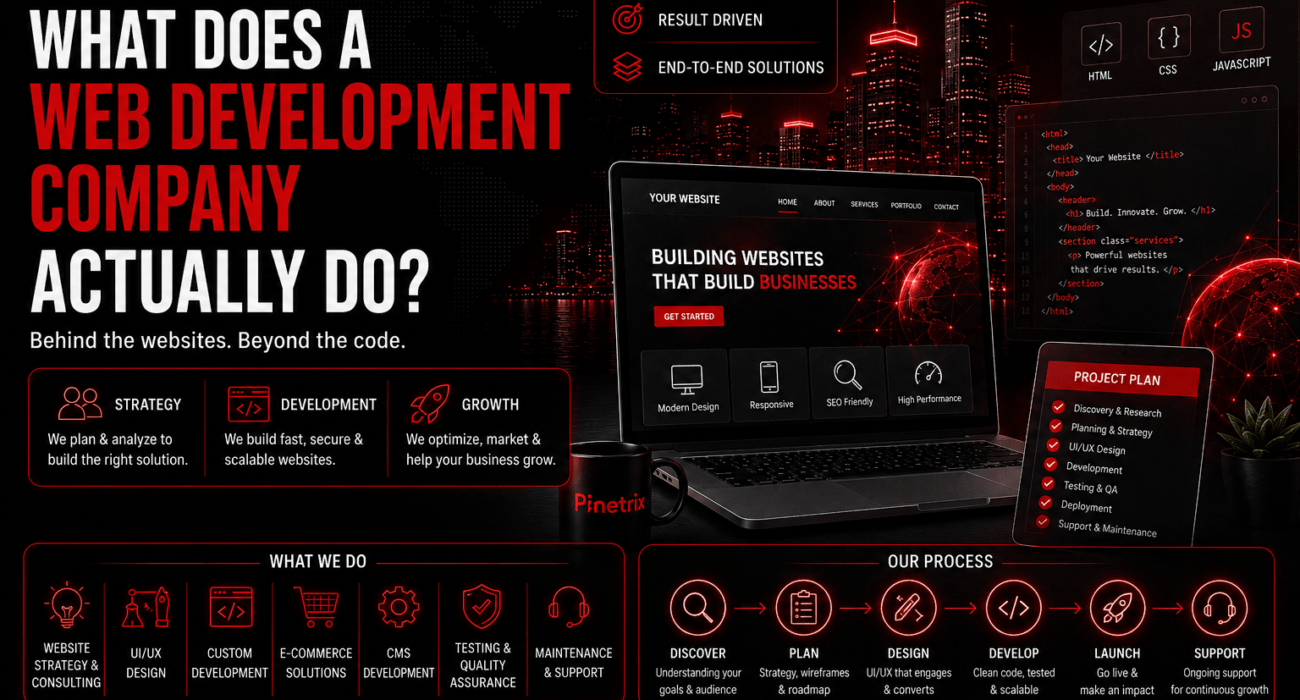
A web development company plans, builds, tests, launches, and maintains websites and web applications based on a business’s technical and commercial requirements. Its work can include front-end development, back-end programming, databases, APIs, eCommerce functionality, third-party integrations, performance optimization, security, and ongoing maintenance.
Pinetrix helps businesses turn these requirements into scalable web solutions through experienced technical teams, structured development processes, and ongoing support. Whether you need a professional business website, eCommerce platform, or custom web application, understanding what a web development company actually does can help you choose the right development partner.
What Does a Web Development Company Do?
A web development company can help businesses with:
- Discovery & Planning: Converts business requirements into a technical roadmap, project scope, and development plan.
- UI/UX & Front-End Development: Builds responsive interfaces using technologies such as HTML, CSS, JavaScript, React, and Next.js.
- Back-End Development: Creates server-side functionality, databases, authentication, APIs, and business logic.
- CMS & eCommerce Development: Builds and customizes websites using platforms such as WordPress, Webflow, Shopify, and WooCommerce.
- Integrations & Automation: Connects websites with CRMs, payment systems, marketing platforms, APIs, and other business tools.
- Testing, Security & Performance: Tests functionality, improves performance, addresses security risks, and prepares the website for launch.
- Maintenance & Support: Provides updates, troubleshooting, monitoring, security maintenance, and future improvements.
Web Design vs. Web Development: What Is the Difference?
Web design and web development work together, but they solve different problems. Web design focuses on how a website looks, feels, and guides visitors through the user experience. Web development turns that design into a functional, secure, and scalable website or web application.
For example, a designer may create the layout, typography, navigation, and user interface in Figma, while developers use technologies such as HTML, CSS, JavaScript, React, Node.js, or Python to make those designs work in a real-world environment.
| Web Design (UI/UX) | Web Development |
| Visual layout and page structure | Functional website and application code |
| Brand colors and typography | Front-end and back-end functionality |
| Wireframes and prototypes | APIs, databases, authentication, and integrations |
| User experience and navigation | Performance, security, and scalability |
| Tools such as Figma | Technologies such as React, Next.js, Node.js, and Python |
| Focuses on what users see | Focuses on how the website works |
How Do Web Design and Development Work Together?
A successful website often requires both disciplines. Design establishes the user experience, while development makes that experience functional.
For a simple business website, one professional may handle both design and development. More complex projects such as eCommerce platforms, SaaS products, customer portals, and custom web applications may require separate UI/UX designers, front-end developers, back-end developers, QA specialists, and DevOps professionals.
If you only need a visual concept, web design may be sufficient. If you need a fully functional, integrated, and scalable digital platform, you need development as well.
6 Core Services of a Web Development Company
A professional web development company in US can provide everything from initial technical planning to post-launch support.
1. Custom Web Application Development
When a business needs functionality that standard website builders cannot provide, developers can build a custom web application.
Examples include:
- SaaS platforms
- Customer portals
- Internal dashboards
- Booking systems
- Membership platforms
- Business management applications
- Custom online marketplaces
Technologies such as React, Next.js, Node.js, Python, and PostgreSQL can be used depending on the application’s requirements.
The goal is not simply to write code. The development team must create an architecture that can support the application’s users, data, integrations, security requirements, and future growth.
2. CMS & eCommerce Development
Many businesses don’t need a completely custom application. A content management system or eCommerce platform may provide everything they need.
Web developers can build and customize platforms such as:
- WordPress
- Webflow
- Shopify
- WooCommerce
Development work can include custom themes, functionality, plugins, payment integrations, product catalogs, checkout optimization, and third-party integrations.
The right platform depends on the business rather than simply choosing the newest technology.
3. API Integration & Business Automation
Modern websites rarely operate independently.
A web development company can connect your website with tools such as:
- CRM systems
- Payment processors
- Marketing platforms
- ERP systems
- Analytics platforms
- Email systems
- Customer databases
- Internal business applications
Developers commonly use REST APIs, GraphQL, webhooks, and custom integrations to allow different systems to exchange information.
For example, a customer submitting a form on a website could automatically create a CRM record, trigger an email workflow, and send the information to an internal system.
4. Database & Cloud Infrastructure
Applications that handle customer accounts, transactions, products, or other structured information require reliable data architecture.
Developers may work with databases such as PostgreSQL, MySQL, or MongoDB, depending on the project’s requirements.
Cloud infrastructure can also be configured through providers such as AWS, Vercel, or Netlify.
A development team may be responsible for:
- Database architecture
- Server configuration
- Deployment
- Backups
- Monitoring
- Performance optimization
- Scaling infrastructure
This becomes increasingly important as traffic, data volume, and application complexity grow.
5. Website Security & Performance Optimization
A website needs to be both usable and technically reliable.
Development teams can improve performance through techniques such as:
- Image and asset optimization
- Caching
- Code optimization
- CDN configuration
- Database optimization
- Efficient API requests
- Server-side improvements
Security work may include:
- SSL/TLS configuration
- Secure authentication
- Access controls
- Dependency updates
- Vulnerability monitoring
- Firewall and server protections
- Secure data handling
Good technical performance can improve user experience and support strong Core Web Vitals performance, while appropriate security practices help reduce operational risks.
6. Quality Assurance & Testing
A website should not go live simply because the development team has finished writing the code.
QA testing can evaluate:
- Forms and lead submissions
- User registration and login
- Payment flows
- APIs and integrations
- Mobile responsiveness
- Browser compatibility
- Navigation
- Performance
- Error handling
- Security-related functionality
Testing helps identify problems before they affect customers and revenue.
The Step-by-Step Web Development Process
A professional web development company follows a structured process to turn business requirements into a reliable website or web application.
Discovery → Architecture & Design → Development → QA & Testing → Launch & Maintenance
| Stage | What Happens | Business Outcome |
| 1. Discovery & Planning | Requirements, goals, features, integrations, users, and technical requirements are defined. | Clear scope and realistic roadmap |
| 2. Architecture & Design | User flows, wireframes, database structure, and technology stack are planned. | Validated design and technical foundation |
| 3. Development | Front-end, back-end, APIs, databases, CMS, and integrations are built. | Functional website or application |
| 4. QA & Testing | Functionality, responsiveness, integrations, security, and browser compatibility are tested. | Stable, launch-ready product |
| 5. Launch & Support | The website is deployed, monitored, maintained, and improved. | Reliable long-term performance |
This process helps reduce scope creep, technical problems, unexpected costs, and expensive post-launch fixes.
Who Works on a Web Development Project?
One major advantage of working with a development company is access to multiple technical disciplines without hiring every specialist individually.
Depending on project requirements, the team may include:
- UI/UX Designer: Creates wireframes, user flows, prototypes, and interface designs.
- Front-End Developer: Builds the user-facing portion of the website or application.
- Back-End Developer: Handles server logic, databases, APIs, authentication, and business processes.
- Full-Stack Developer: Works across both front-end and back-end development.
- QA Specialist: Tests functionality, usability, compatibility, and application reliability.
- DevOps/Cloud Specialist: Handles deployment, infrastructure, monitoring, and development pipelines.
- Project Manager: Coordinates communication, timelines, deliverables, and project requirements.
Not every project needs all of these roles. A simple business website may require only a few specialists, while a complex SaaS application may require a much larger team.
Post-Launch Web Development Support & Maintenance
Launching your website is not the end of the development process. Regular maintenance helps keep your website secure, fast, compatible, and reliable as technologies, browsers, integrations, and business requirements change.
A professional development partner can provide ongoing support to identify issues early, maintain the underlying technology, and improve performance over time.
What Ongoing Web Maintenance Includes
| Maintenance Area | Typical Activities | Business Benefit |
| Security & Updates | Security patches, dependency updates, vulnerability checks, CMS updates | Reduces security risks and unexpected downtime |
| Performance & Infrastructure | Database optimization, caching, CDN configuration, server monitoring | Keeps applications responsive as traffic grows |
| Backups & Recovery | Automated backups and recovery procedures | Helps protect important business data |
| Compatibility Updates | Browser, framework, plugin, and integration updates | Prevents functionality from breaking |
| Bug Fixes & Improvements | Troubleshooting, performance fixes, and technical enhancements | Keeps the platform functional and aligned with business needs |
Without ongoing maintenance, outdated software, dependencies, integrations, or infrastructure can gradually create security vulnerabilities, compatibility issues, performance problems, and technical debt.
For businesses that depend on their website for leads, sales, customer accounts, or daily operations, ongoing support can be just as important as the initial development.
When Should Your Business Hire a Web Development Company?
You don’t necessarily need a development company for every website.
A freelancer or DIY platform may be enough for a simple landing page or basic informational website. However, professional development becomes more valuable when your business has technical requirements that go beyond basic page creation.
Consider working with a web development company when you need:
| Business Challenge | Possible Technical Requirement |
| Slow website performance | Code, database, hosting, or asset optimization |
| Broken forms or integrations | API and back-end troubleshooting |
| Complex eCommerce requirements | Custom functionality and integrations |
| Customer portals | Authentication and database development |
| Custom business systems | Web application development |
| Scaling problems | Improved architecture and infrastructure |
| Security concerns | Security updates and technical hardening |
| Ongoing development | Dedicated development and maintenance support |
The biggest benefit isn’t simply having “more developers.” It’s having access to the right combination of technical skills for your specific project.
How Much Does a Web Development Company Cost?
Web development pricing depends on project scope, design requirements, functionality, technology, integrations, and ongoing support.
As a general planning range:
- Basic business website: A few thousand dollars
- Custom-designed business website: Several thousand to tens of thousands
- eCommerce website: Often starts in the thousands and increases with customization
- Custom web application: Can range from tens of thousands to well over $100,000
- SaaS or enterprise platform: May require a significantly larger development investment
A development company should ideally price the project based on its actual requirements rather than providing an arbitrary one-size-fits-all figure.
Build a Website That Supports Your Business Goals
Your website is more than a collection of pages. For many businesses, it is a lead-generation channel, sales platform, customer portal, or core operational system.
Choosing the right development partner can help you avoid unnecessary technical complexity, reduce development risks, and build a platform that can evolve with your business.
Pinetrix provides end-to-end web development support from planning and architecture to development, testing, deployment, and ongoing maintenance.
If you’re planning a new website or need to improve an existing platform, explore our Web Development Services or Contact Pinetrix to discuss your project requirements and development options.
Frequently Asked Questions
What does a web development company do compared to a freelancer?
A web development company can provide access to multiple specialists, including designers, developers, QA professionals, project managers, and DevOps specialists. A freelancer typically works independently and may be a better fit for smaller, clearly defined projects.
How much does it cost to hire a web development company?
The cost depends on the project’s size, functionality, technology, integrations, and support requirements. Basic business websites may cost a few thousand dollars, while custom eCommerce platforms and web applications can require tens or hundreds of thousands of dollars.
What technologies do modern web development companies use?
Technology depends on project requirements. Common options include React, Next.js, JavaScript, Node.js, Python, PostgreSQL, WordPress, Webflow, Shopify, AWS, Vercel, and Netlify.
How long does it take to build a website?
A simple business website may take several weeks, while eCommerce websites and custom web applications can take several months. The timeline depends on scope, content readiness, integrations, design complexity, testing, and revisions.
Why should I choose Pinetrix for web development?
Pinetrix combines web development, technical expertise, and scalable delivery models to help businesses build and maintain reliable digital platforms. Whether you need a business website, custom web application, eCommerce solution, or ongoing development support, Pinetrix can help you plan the right technical approach for your requirements.