
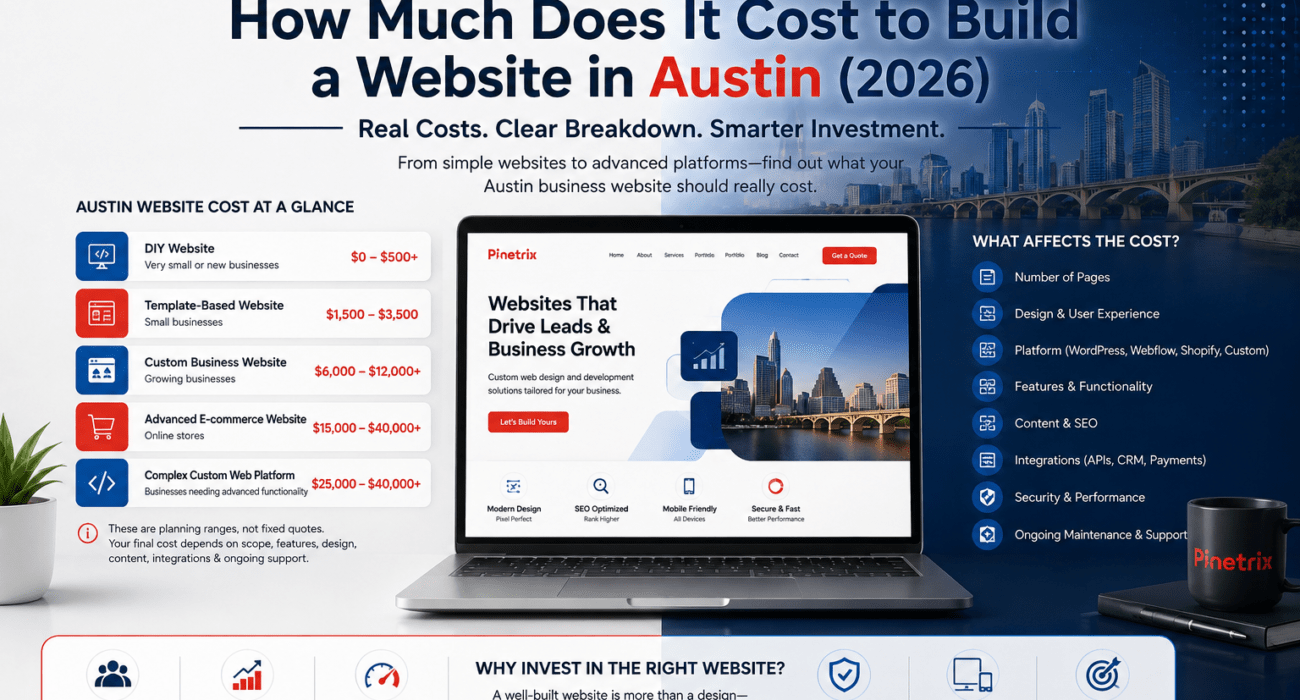
Building a website in Austin can cost anywhere from a few hundred dollars for a DIY site to $40,000+ for a complex custom website or e-commerce platform. For most Austin small and mid-sized businesses, professionally developed websites typically range from $1,500 to $15,000+, depending on design, functionality, platform, SEO, integrations, and ongoing support. At Pinetrix, we approach website development as a business investment not just a design project building responsive, SEO-ready websites designed to strengthen your online presence and turn more visitors into qualified leads.
If you’re comparing Austin web design pricing, don’t choose a provider based only on the lowest quote. A cheaper website can become more expensive later if it lacks mobile responsiveness, SEO foundations, security, performance optimization, or the functionality your business needs to generate leads.
Austin Website Design Cost at a Glance
| Website Type | Typical Cost | Best For |
| DIY Website | $0–$500+ | Very small or new businesses |
| Template-Based Website | $1,500–$3,500 | Small businesses |
| Custom Business Website | $6,000–$12,000+ | Growing businesses |
| Advanced E-commerce Website | $15,000–$40,000+ | Online stores |
| Complex Custom Web Platform | $25,000–$40,000+ | Businesses needing advanced functionality |
These are planning ranges, not fixed Austin market quotes. Your actual cost depends heavily on scope and what is included in the project.
What are you actually paying for?
A professional website isn’t simply a collection of pages. Your budget may cover:
- UX/UI and responsive design
- Wireframes and prototypes
- Website development and custom code
- WordPress, Webflow, Shopify, or another platform
- Content creation and copywriting
- SEO setup and schema markup
- API integrations
- Payment gateways
- Security and SSL
- Performance optimization
- Testing and launch
- Ongoing maintenance and support
That’s why two Austin businesses can receive quotes of $3,000 and $12,000 for what initially sounds like “the same website.” The difference is usually in the scope, technical requirements, customization, expertise, and long-term business goals.
What Determines the Cost of a Website in Austin?
The biggest mistake businesses make is asking only:
“How much does a website cost?”
A better question is:
“What does my business actually need the website to accomplish?”
A five-page brochure website and a custom lead-generation platform may both be called a “business website,” but they require completely different levels of planning and development.
Your final website design cost in Austin, TX can change based on:
Number of pages: A 5-page website generally costs less than a 30-page website with multiple service and industry sections.
Design requirements: A customized UX/UI experience requires more work than installing and modifying a pre-built template.
Platform: WordPress, Webflow, Shopify, and custom technologies each have different development requirements.
- Functionality: Booking systems, calculators, customer portals, payment processing, memberships, dashboards, and API integrations can significantly increase development costs.
Content and SEO: Professional copywriting, keyword research, technical SEO, images, and schema markup can be separate project components.
Performance and security: A serious business website may require CDN configuration, SSL, security monitoring, caching, backups, and performance optimization.
Ongoing support: Website maintenance, updates, security monitoring, hosting, and technical support can create recurring costs after launch.
For a deeper comparison of development approaches, see our guide on Custom Website vs WordPress: Which Is Right for Your Business? — especially if you’re deciding whether the additional investment in custom development is justified.
The cheapest website isn’t always the cheapest business decision
If your website is expected to generate leads, establish credibility, rank in search, support sales, or integrate with other business systems, the initial development price is only one part of the investment.
A professionally built website should be treated as a business asset, not simply an online brochure.
That’s particularly important for Austin businesses competing in crowded markets where potential customers may compare several providers before contacting one.
If you’re still unsure whether your current website is holding your business back, our guide on 10 Signs Your Business Needs a New Website in 2026 can help you evaluate it before spending money on a redesign or rebuild.
Need a website that does more than look professional?
Pinetrix helps businesses build modern, responsive, SEO-ready websites designed around their business goals—not just a list of pages. Our web development approach can combine UX/UI, development, SEO foundations, performance, security, integrations, and ongoing scalability so your website is built to support growth.
Ready to find out what your Austin business website should cost?
Get a tailored website development estimate from Pinetrix.
How Much Does Web Design Cost by Provider?
Once you know the broad price range, the next question is why one Austin website costs $2,000 while another costs $10,000 or more.
The answer usually comes down to how the website is designed and built, the platform you choose, the functionality you need, and the level of expertise and support included.
DIY vs. Freelancer vs. Web Development Company
Austin businesses typically have several options when choosing who will build their website:
| Option | Typical Cost | Best For | Main Trade-Off |
| DIY Website Builder | $0–$500+ | Basic online presence | Limited customization and technical control |
| Freelancer | $1,500–$5,000+ | Smaller, straightforward projects | Expertise and support vary |
| Web Development Company | $6,000–$15,000+ | Growing businesses | Higher upfront investment |
| Custom Development Team | $15,000–$40,000+ | Complex websites and platforms | Larger budget and longer development |
These ranges are general planning estimates, not fixed Austin web design rates. The actual quote depends on your project’s scope, functionality, technology, and deliverables.
DIY Website Builders
Platforms such as Wix, Squarespace, and Hostinger can make it possible to launch a basic website with relatively little upfront investment.
They’re suitable when you need:
- A simple online presence
- A small number of pages
- Basic contact functionality
- Limited customization
However, lower upfront costs can come with limitations around:
- Custom UX/UI
- Advanced integrations
- Technical SEO
- Performance optimization
- Custom functionality
- Scalability
- Ongoing technical support
For a business that depends on its website for qualified leads, simply getting a website online may not be enough.
Freelancer Web Designer or Developer
Hiring a freelancer can offer lower Austin web design pricing than a full-service agency, particularly for smaller projects.
A freelancer may be a good choice for:
- Small brochure websites
- Basic WordPress projects
- Landing pages
- Minor redesigns
- Straightforward business websites
The main consideration is scope. One freelancer may be excellent at design but not offer the same depth of development, SEO, security, integrations, testing, or ongoing support as a larger team.
Before hiring a freelancer, ask exactly what’s included in the scope of work, how revisions are handled, who owns the website and its assets, and what support is available after launch.
Professional Web Development Company
A professional web development company in Austin generally costs more because you’re paying for a broader combination of strategy, UX/UI, development, project management, testing, and support.
This can make sense when your website needs to:
- Generate qualified leads
- Support a growing business
- Provide a strong user experience
- Integrate with other software
- Compete in organic search
- Connect with CRM or marketing systems
- Scale as your business grows
The goal isn’t simply to find the cheapest web development company. It’s to find a team whose capabilities match the business outcome you’re trying to achieve.
Custom Web Development
Custom development is typically the highest-cost option because the website or web application is built around specific business requirements rather than assembled primarily from an existing template.
It may involve technologies such as React, Next.js, custom APIs, databases, authentication systems, payment gateways, or third-party integrations.
Custom website development is generally more appropriate when a business needs functionality that a standard CMS or website builder cannot provide efficiently, such as:
- Custom business logic
- Advanced API integrations
- Customer portals
- Unique workflows
- Complex databases
- Custom dashboards
- Specialized automation
The important question isn’t:
“Which technology is most advanced?”
It’s:
“Which technology gives my business the capabilities it needs without paying for unnecessary complexity?”
That distinction can prevent an Austin business from either overspending on development or underinvesting in a website that cannot support its goals.
WordPress vs. Webflow vs. Shopify vs. Custom Development
The platform you choose can significantly influence both your initial development cost and ongoing expenses.
| Platform | Typical Use | Relative Cost | Best For |
| WordPress | Business websites and content | $$ | SMBs and content-driven businesses |
| Webflow | Marketing and B2B websites | $$–$$$ | Design-focused businesses |
| Shopify | E-commerce | $$–$$$ | Online stores |
| Custom React/Next.js | Advanced websites and applications | $$$$ | Complex business requirements |
WordPress
WordPress website remains a practical choice for many small and mid-sized businesses because it offers flexibility, a large ecosystem, and extensive customization options.
The total cost depends heavily on the theme, plugins, custom development, content, integrations, hosting, and maintenance required.
If you’re deciding between WordPress and a fully custom website, don’t assume one is automatically better. The right choice depends on your goals, budget, functionality, and expected growth.
For a deeper comparison, see Custom Website vs WordPress: Which Is Right for Your Business?
Webflow
Webflow websites can be attractive for businesses that prioritize visual design, responsive layouts, and marketing-focused websites.
It can work particularly well for B2B companies, professional services firms, startups, and businesses that want greater design control without building every component from scratch.
Shopify
Shopifywebsite development is primarily designed for e-commerce. Costs can increase when you add custom themes, apps, product integrations, inventory systems, payment functionality, or other advanced requirements.
As a result, an e-commerce website design cost in Texas can be considerably higher than that of a basic service-business website.
Custom Development
Custom development provides greater control over functionality and architecture, but it also requires a larger investment.
It’s worth considering when your website needs:
- Custom business logic
- Advanced API integrations
- Customer portals
- Complex databases
- Custom dashboards
- Specialized automation
The best platform isn’t necessarily the most powerful one. It’s the one that provides the right capabilities for your business without adding unnecessary cost and complexity.
What Should You Budget for Your Website?
Instead of starting with a fixed number, work backward from what your business needs the website to accomplish.
If you only need an online presence:
A template-based WordPress, Webflow, or similar website may be sufficient.
If you need a lead-generation website:
Budget more for custom UX/UI, conversion-focused content, SEO foundations, analytics, performance, forms, and integrations.
If you’re selling online:
Expect additional costs for product architecture, payment processing, inventory, shipping, apps, and security.
If you need unique functionality:
Custom development may be necessary when your website requires portals, dashboards, APIs, automation, or specialized workflows.
The goal isn’t to spend as much as possible. It’s to invest enough to build the right website for the outcome you expect.
Hidden Costs of Building a Website in Austin
The initial development quote is only one part of your total website budget. Many businesses focus on the design and development price, then discover additional expenses for hosting, security, maintenance, content, SEO, or third-party tools after launch.
Before comparing quotes, make sure you understand what is included and what you’ll pay separately.
What Additional Costs Should You Expect?
1. Domain and Hosting
Your domain is the address customers use to find your website, while hosting provides the infrastructure needed to keep it online.
Hosting costs can vary depending on whether you use:
- Shared hosting
- VPS hosting
- Managed WordPress hosting
- Cloud hosting
A low-cost hosting plan may be adequate for a simple website, while businesses with higher traffic, e-commerce functionality, or demanding applications may need more robust infrastructure.
2. SSL and Website Security
HTTPS/TLS encryption helps protect information exchanged between your website and visitors. Broader website security may also involve:
- Malware protection
- Backups
- Firewall configuration
- Security monitoring
- Software updates
- Vulnerability management
Tools such as Cloudflare, Sucuri, and iThemes Security may form part of an ongoing security strategy depending on your website’s technology and requirements.
Security shouldn’t be treated as an optional add-on particularly if your website collects customer information or connects to business systems.
3. Website Maintenance
A website isn’t necessarily finished when it goes live.
Your website maintenance cost in Austin can include:
- CMS and plugin updates
- Security monitoring
- Backups
- Bug fixes
- Performance optimization
- Content updates
- Technical support
Basic maintenance may cost relatively little, while websites requiring ongoing development, security, content, or technical support can require a significantly larger monthly budget.
Ask every provider whether maintenance is included in the initial quote or charged separately, and make sure you understand exactly what the maintenance plan covers.
4. SEO and Content
A website can look excellent and still struggle to generate organic traffic if SEO isn’t considered during development.
Additional work may include:
- Keyword research
- SEO-focused copywriting
- On-page optimization
- Internal linking
- Schema markup
- Image optimization
- Technical SEO
- Local SEO
- Search Console and analytics configuration
For an Austin business competing for local customers, building SEO into the website from the beginning can help avoid expensive structural changes later.
That’s also why Why Is SEO Important During Website Development? should be considered before approving a project scope.
5. API Integrations and Third-Party Tools
A website becomes more complex when it needs to communicate with other systems.
Examples include:
- CRM integrations
- Email marketing platforms
- Booking systems
- Payment gateways
- Accounting software
- Inventory systems
- Customer portals
- Maps and location services
- Custom APIs
A basic contact form may require very little development. Connecting a website to several business systems can require substantially more planning, development, testing, and maintenance.
6. Copywriting, Photography, and Branding
Don’t overlook the content itself.
A professional website may require:
- Original website copy
- Service-page content
- Product descriptions
- Professional photography
- Brand messaging
- Graphics
- Video
- Custom illustrations
If these aren’t included in your web development quote, you’ll need to budget for them separately.
What This Means for Your Total Website Cost
The number on the initial proposal isn’t necessarily your total investment.
Your long-term cost may include:
Development + Content + SEO + Security + Hosting + Maintenance + Future Improvements
That’s why two websites with similar page counts can have very different total costs.
For businesses focused on growth, the better question isn’t simply “How cheap can I get a website?”
It’s:
“What investment will give my business the website it actually needs?”
If you’re evaluating whether your current website is worth improving or replacing, [Why Every Business Needs a Professional Website in 2026] can help you assess the broader business value of a professional website.
How to Compare Web Development Quotes in Austin
Two web development companies in Austin may quote $7,000 and $12,000 for what appears to be the same project.
Don’t automatically choose the $7,000 quote.
Before comparing prices, compare what you’re actually getting.
Watch Out for These Website Pricing Red Flags
Be cautious when a quote:
- Gives you one unexplained lump-sum price
- Doesn’t define the scope of work
- Doesn’t specify the number of pages
- Promises “unlimited” features without explaining what’s included
- Doesn’t clarify website ownership
- Has no revision policy
- Excludes essential functionality without making it clear
- Offers an unusually low price without explaining what’s missing
A professional, itemized quote should make it easy to understand where your money is going and what you’ll receive in return.
And remember: affordable web design in Austin TX doesn’t necessarily mean the lowest possible price. It means getting the capabilities your business needs at a reasonable total cost.
Don’t Judge a Website Only by Its Upfront Price
A $2,000 website that needs a major rebuild two years later may ultimately cost more than a $7,000 website that was properly planned and built from the beginning.
Your real investment can include:
Development + Content + SEO + Security + Maintenance + Hosting + Future Improvements
That’s why businesses should evaluate a website based on value, functionality, scalability, and its ability to support business growth, rather than focusing only on the initial invoice.
If you’re unsure whether your existing website needs improvement or a complete rebuild, see Why Every Business Needs a Professional Website in 2026.
How to Choose the Right Web Development Company in Austin
Once you understand potential costs, the next question is often more important:
How do I choose the right web development company for my Austin business?
The lowest quote isn’t necessarily the best value, and the most expensive provider isn’t automatically the best either.
Look for a development partner that understands your business goals, customers, technology requirements, SEO, and long-term growth.
Look for a Clear, Itemized Scope of Work
A professional proposal should explain exactly what you’re paying for, including:
- Number of pages
- UX/UI design
- Development platform
- Responsive design
- Content requirements
- SEO deliverables
- Integrations
- Testing
- Launch
- Revisions
- Post-launch support
If a provider gives you only a single price without explaining what’s included, ask for an itemized proposal before moving forward.
Make Sure Development and SEO Work Together
Your developer doesn’t necessarily need to be your entire marketing team, but SEO should be considered during development.
Important foundations include:
- Mobile responsiveness
- Site architecture
- Page speed
- Crawlability
- Metadata
- Internal linking
- Schema markup
- Image optimization
- Clean URLs
- Technical performance
A beautiful website that search engines struggle to understand can become an expensive missed opportunity.
That’s why Why Is SEO Important During Website Development? is worth reading before approving a project scope.
How Much Should an Austin Business Spend on a Website?
There isn’t one correct budget. Instead, match your investment to your business requirements.
If you only need an online presence:
A basic template-based website may be enough.
If you need consistent leads:
Invest more heavily in UX/UI, conversion-focused design, SEO, content, performance, analytics, and lead capture.
If you’re selling online:
Budget for e-commerce functionality, product architecture, payments, shipping, inventory, security, and integrations.
If you need unique functionality:
Consider custom development when your business depends on APIs, automation, customer portals, dashboards, custom workflows, or specialized systems.
The goal isn’t to spend as much as possible. It’s to invest enough to build the right website for the outcome you expect.
Should I redesign my existing website or build a new one?
A redesign may be appropriate when your existing website has a sound technical foundation but needs improvements to its design, UX, content, or conversion performance. A new build may make more sense when the existing platform, architecture, code, or functionality prevents meaningful improvements.
For a more detailed decision framework, see Should I Redesign My Existing Website or Build a New One?
Build a Website That Becomes a Business Asset
For an Austin business, the right website should do more than establish an online presence.
Pinetrix provides web and mobile app development solutions for businesses that need more than a basic template. Our approach brings together UX/UI, web development, SEO-ready foundations, performance, security, integrations, and scalable technology to create websites aligned with business goals.
If you’re comparing Austin web design pricing and want a website built around your actual business requirements, don’t settle for a generic package.
Ready to Build a Website Designed for Growth?
Talk to Pinetrix about your Austin website development project
Frequently Asked Questions
How much does a 5-page website cost in Austin?
A professionally developed 5-page business website can range from roughly $1,500 to $10,000+, depending on whether it’s template-based or custom, the UX/UI requirements, content, SEO, integrations, and development complexity.
Why are web designers in Austin more expensive?
Austin has a strong technology and professional-services ecosystem, and specialized designers, developers, and agencies may charge different rates based on their expertise, project complexity, and scope. There isn’t one standard Austin rate.
Do I need ongoing website maintenance?
For most professional business websites, yes. Updates, security monitoring, backups, bug fixes, content changes, and performance improvements help keep a website secure, functional, and up to date after launch.
Is WordPress good for small business websites?
Yes. WordPress can be an effective choice for small businesses that need a flexible, content-friendly website without the cost of completely custom development. The quality of the final website still depends heavily on its design, development, plugins, hosting, security, and maintenance.
Can a business website generate more leads?
Yes. A website can support lead generation when it combines clear messaging, strong UX, relevant content, fast performance, mobile responsiveness, SEO, trust signals, and effective calls to action. Simply having a website, however, doesn’t guarantee leads.
Should I redesign my existing website or build a new one?
A redesign may be appropriate when your existing website has a sound technical foundation but needs improvements to its design, UX, content, or conversion performance. A new build may make more sense when the existing platform, architecture, code, or functionality prevents meaningful improvements.