
Quick Answer
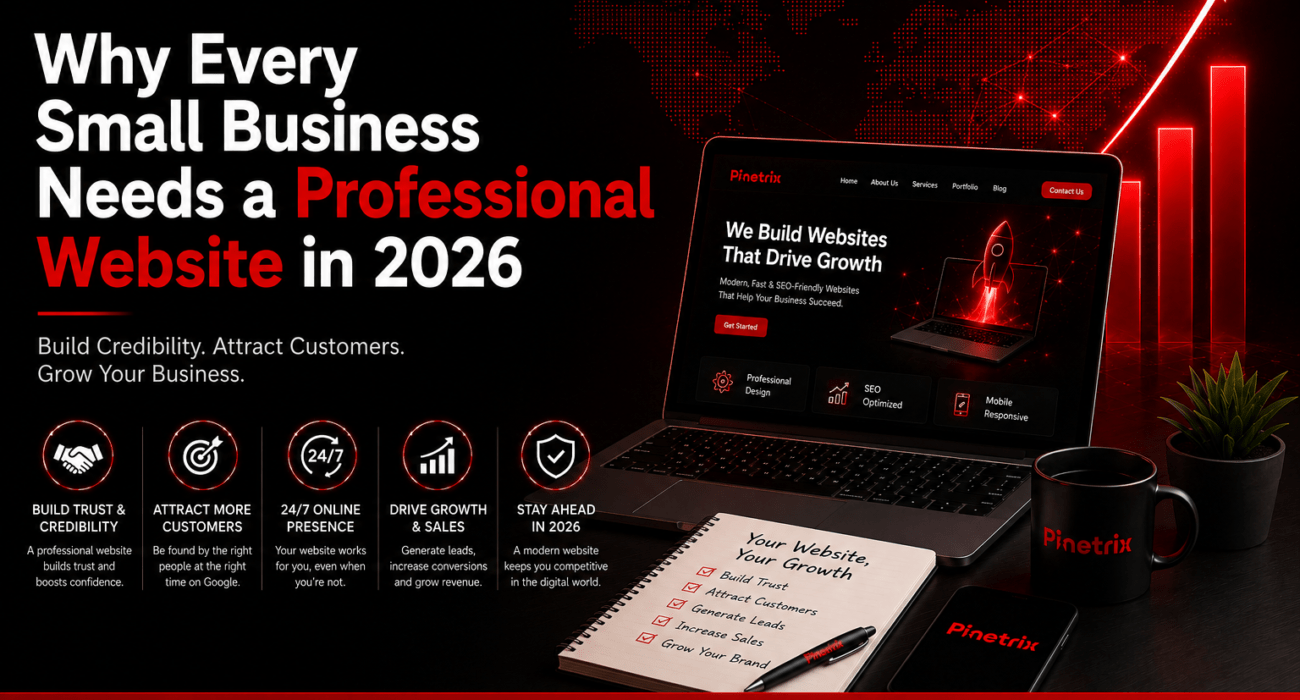
Every small business needs a professional website in 2026 because it’s the only digital asset you fully own. While social media platforms, online marketplaces, and directories can help you reach customers, they don’t give you complete control over your visibility, branding, or customer data. If you’re planning to build or upgrade your business website, working with an experienced web development partner like Pinetrix can help you create a website that’s designed to attract customers, generate leads, and support long-term business growth.
If Your Business Doesn’t Have a Website in 2026, You’re Losing More Than Customers
Many business owners still rely on Facebook, Instagram, Google Business Profile, or word-of-mouth referrals to attract customers. While these channels are valuable, they were never designed to replace a professional business website.
Today’s customers rarely make decisions after seeing only a social media profile. They research businesses on Google, compare multiple companies, read reviews, and increasingly rely on Google AI Overviews, ChatGPT, Gemini, and Perplexity for recommendations. Businesses with a fast, SEO-friendly, and professionally developed website are far more likely to earn trust, appear in search results, and convert visitors into customers than those relying only on social platforms.
A professional website isn’t just an online brochure anymore, it’s your digital headquarters, your lead generation platform, and one of the most valuable business assets you can own.
Why This Matters More Than Ever in 2026
The digital landscape has changed dramatically over the last few years.
Consumers expect every legitimate business to have a website that’s fast, mobile-friendly, secure, and easy to navigate. Whether someone needs a local contractor, a law firm, a marketing agency, or an online retailer, their buying journey almost always starts with online research.
Today’s customers expect to:
- Learn about your services instantly.
- Compare your business with competitors.
- Read customer reviews and testimonials.
- Request quotes online.
- Book appointments without making a phone call.
- Access your business from any device.
If your business can’t meet those expectations, customers can move to another company within seconds.
This is why investing in a professional website for small business is no longer optional, it’s a competitive advantage.
Website vs. Social Media: Which One Gives You More Control?
Many businesses ask:
“Do I really need a website if my business is already on Facebook or Instagram?”
The short answer is yes.
Here’s why.
| Feature | Professional Website | Social Media Profile |
| Full ownership | Yes | No |
| SEO visibility | High | Limited |
| Lead generation | Complete control | Platform dependent |
| Branding | Fully customizable | Restricted |
| Customer data | You own it | Platform owns it |
| Algorithm risk | Low | High |
| Long-term business asset | Yes | No |
Social media is excellent for engagement, but it’s still rented digital space. Algorithms change, advertising costs increase, accounts can be restricted, and your organic reach can disappear overnight.
Your website, on the other hand, is digital real estate that your business owns and controls.
Your Website Helps You Own Customer Relationships
A professional website does more than showcase your services; it helps you build long-term relationships with your customers.
Unlike social media platforms, your website allows you to collect zero-party data, which is information customers willingly share, such as contact forms, email subscriptions, consultation requests, newsletter sign-ups, or service preferences.
As third-party cookies continue to disappear, this data becomes even more valuable. Instead of depending entirely on advertising platforms, you can build your own email list, personalize customer experiences, and create long-term marketing campaigns using information your audience has chosen to share.
In other words, your website doesn’t just generate traffic; it helps you build a customer database that becomes more valuable as your business grows.
1. A Professional Website Builds Instant Trust and Credibility
First impressions happen online.
Customers judge your business within seconds. A professional website with clear branding, customer reviews, HTTPS security, fast loading speeds, Responsive Web Design, optimized Core Web Vitals, and accessibility (WCAG) immediately builds credibility. These features improve user experience while also supporting SEO and long-term website performance.
Without a website, potential customers may wonder:
- Is this business legitimate?
- Are they still operating?
- Can I trust them with my money?
- Do they provide professional services?
A professional website answers these questions before a customer even contacts you.
It also gives you complete control over how your brand is presented something social media profiles simply can’t offer.
For businesses competing in crowded industries, credibility often becomes the deciding factor that turns visitors into customers.
2. Your Website Works as a 24/7 Lead Generation Machine
Unlike a physical office, your website never closes.
While your team is sleeping, meeting clients, or working on projects, your website can continue to:
- Generate inquiries.
- Capture contact forms.
- Accept appointment bookings.
- Showcase your services.
- Answer common customer questions.
- Collect qualified leads.
Instead of depending entirely on phone calls or manual responses, a professionally developed website automates much of the customer journey.
Features like online booking systems, AI chatbots, quote request forms, CRM integrations, and automated follow-up emails help reduce administrative work while improving the customer experience.
Businesses that invest in web development services often discover that their website becomes one of their most consistent sources of qualified leads over time.
3. A Professional Website Helps Customers Find Your Business on Google and AI Search
In 2026, being online isn’t enough; your business needs to be discoverable.
When someone searches for services like “website development company,” “accounting services near me,” or “best marketing agency for small business,” Google doesn’t randomly choose which businesses to show. It prioritizes websites that demonstrate expertise, relevance, and a great user experience.
A professionally developed website also creates the technical foundation that search engines need to understand and rank your business. Features like Schema Markup, Responsive Web Design, optimized Core Web Vitals, HTTPS security, XML sitemaps, and a properly structured site architecture help Google better interpret your content. These same signals also make it easier for AI-powered search engines to identify your business, understand your services, and recommend your website in relevant search experiences.
That’s where Search Engine Optimization (SEO) and Generative Engine Optimization (GEO) come in.
A professionally built website gives you the foundation to:
- Rank for valuable search terms.
- Appear in Google AI Overviews.
- Improve visibility in AI-powered search tools like ChatGPT and Perplexity.
- Attract consistent organic traffic without paying for every click.
- Build long-term authority in your industry.
Unlike social media posts that disappear within hours or days, well-optimized website content can continue generating traffic and leads for months or even years.
This is why businesses investing in SEO-friendly website development often see stronger long-term growth than those relying only on paid ads or social media.
4. Your Website Is a Business Asset You Own; Not Digital Space You Rent
One of the biggest mistakes small businesses make is treating social media as their primary online presence.
The reality is simple:
Facebook, Instagram, LinkedIn, and other platforms belong to their respective companies not to your business.
They control:
- Algorithms
- Reach
- Advertising costs
- Content visibility
- Account policies
A single algorithm update or account issue can dramatically reduce your visibility overnight.
A professional website is different.
It’s your digital property.
You decide:
- What content to publish.
- How your brand looks.
- Which services to promote.
- How customers contact you.
- What information you collect.
Think of it this way:
Owning only a social media page is like renting a storefront in a shopping mall.
Owning a professional website is like owning the building itself.
One gives you limited control.
The other becomes a long-term business asset that grows in value over time.
5. A Professional Website Converts Visitors Into Paying Customers
Getting traffic is only half the challenge.
The real goal is turning visitors into customers.
A professionally designed website is built with conversion in mind.
Instead of simply displaying information, it guides visitors toward taking action.
For example, a visitor can:
- Request a quote.
- Book a consultation.
- Schedule a demo.
- Download a guide.
- Call your business.
- Fill out a contact form.
Every page should have a clear purpose.
That’s why professional websites use elements like:
- Clear calls-to-action (CTAs)
- Customer testimonials
- Trust badges
- Case studies
- FAQs
- Contact forms
- Fast-loading pages
Together, these features improve conversion rate optimization (CRO) and help transform website visitors into qualified leads.
Website Performance Matters
A beautiful website won’t deliver results if it’s slow or difficult to use.
Website performance directly affects user experience and conversions. Fast-loading pages, mobile-first design, secure HTTPS connections, optimized images, reliable hosting, and Content Delivery Networks (CDNs) help reduce bounce rates, improve SEO, and keep visitors engaged long enough to become qualified leads.
That’s why professional websites focus on:
- Fast loading speeds
- Mobile-first performance
- Secure HTTPS connections
- Reliable hosting
- Content Delivery Networks (CDNs)
- Optimized images
- Clean website architecture
6. Automation Saves Time, Reduces Costs, and Improves Customer Experience
Running a small business means wearing multiple hats.
A professional website can automate many repetitive tasks that would otherwise consume valuable time.
Professional websites can automate appointment scheduling, quote requests, live chat, CRM updates, payment collection, email follow-ups, and third-party API integrations. As your business grows, these automations improve efficiency while reducing repetitive manual work.
Instead of answering the same questions repeatedly, your website can provide information automatically and collect leads even outside business hours.
Over time, this reduces administrative workload, improves response times, and creates a better customer experience.
For growing businesses, automation isn’t just convenient; it’s a competitive advantage.
7. A Website Gives You Better Marketing ROI Than Relying on One Channel
Many small businesses spend thousands of dollars on advertising every year but still depend entirely on platforms they don’t control.
A website changes that.
Every marketing channel can drive visitors back to a single destination that you own.
For example:
- Google Ads
- Facebook Ads
- LinkedIn campaigns
- Email marketing
- Local SEO
- Content marketing
- Social media posts
All of these channels become more effective when they lead visitors to a professional website designed to convert.
Without a website, you’re sending potential customers to platforms with limited branding, fewer conversion opportunities, and less control over the user experience.
A website becomes the center of your entire digital marketing strategy.
This is one reason many businesses choose custom website development instead of relying solely on free website builders or social media pages.
8. The Cost of Not Having a Professional Website
Many small business owners ask:
“Can I afford a professional website?”
A better question is:
Can you afford not to have one?
Every month without a professional website could mean:
- Missed leads from Google searches.
- Lost sales to competitors with a stronger online presence.
- Lower customer trust.
- Fewer inquiries and bookings.
- Limited visibility in AI-powered search results.
Consider a simple example: if your website costs around $2,500 but helps recover just three customers worth $1,000 each, it has already generated more value than its initial investment. Instead of viewing a website as an expense, think of it as a business asset that continues producing leads and revenue over time.
A website shouldn’t be viewed as an expense; it should be viewed as a long-term business asset that continues generating value over time.
Is a Professional Website Worth It for Small Businesses in 2026?
Absolutely.
Whether you run a local service business, a consulting firm, an online store, or a growing startup, your website becomes the foundation of your digital presence.
It helps you:
- Build trust.
- Generate qualified leads.
- Improve Google visibility.
- Support AI-powered search.
- Automate customer interactions.
- Strengthen your brand.
- Grow your business consistently.
Unlike social media platforms that constantly change their algorithms, your website remains an asset that you own and control.
For businesses planning long-term growth, it’s one of the smartest investments you can make.
For local businesses, a professional website works best alongside a Google Business Profile not as a replacement for it. Your Business Profile helps customers discover your company in local search results and Google Maps, while your website provides the detailed information, credibility, and conversion opportunities that turn visitors into customers. Together, they create a stronger local SEO strategy.
Final Thoughts
In 2026, a professional website is no longer just another marketing tool; it’s the foundation of your online business.
Customers expect to find accurate information, compare services, and contact businesses online before making a decision. At the same time, search engines and AI platforms increasingly rely on high-quality websites to recommend businesses.
If your company depends only on social media or word-of-mouth referrals, you’re limiting your visibility, your lead generation potential, and your future growth.
A professionally built website helps you attract qualified traffic, build credibility, automate customer interactions, and create a digital asset that continues working for your business every day.
If you’re planning to grow your business in the US market, investing in a professional website today can create opportunities that continue paying off for years to come.
Ready to Build a Website That Drives Real Business Growth?
A website should do more than look good; it should help your business get found, build trust, and convert visitors into customers.
If your current website isn’t generating leads or you don’t have one yet; it may be time to invest in a solution built for long-term growth. At Pinetrix, we design and develop high-performance websites tailored to your business goals. Whether you need a custom business website, an eCommerce solution, or a scalable web application, our team focuses on performance, SEO, user experience, and long-term growth.
If you’re ready to create a website that supports your business in 2026 and beyond, explore our Web Development Services and see how the right website can become one of your most valuable business assets.
Frequently Asked Questions
Do small businesses still need a website if they use social media?
Yes. Social media helps you reach potential customers, but it doesn’t replace a professional website. A website gives you complete control over your brand, improves search visibility, and provides a reliable platform for lead generation.
Can a Google Business Profile replace a website?
No. A Google Business Profile is valuable for local visibility, but it provides limited customization and functionality. A professional website allows you to showcase your services, publish helpful content, capture leads, and build long-term authority.
What’s the difference between a professional website and a website builder?
Website builders are suitable for basic websites, but professional websites offer better performance, scalability, security, SEO optimization, and customization to support business growth.
If you’re comparing both options, our guide on Custom Website vs. WordPress explains which solution is best for different business needs.
How does a website help with AI search engines?
AI-powered search engines like ChatGPT, Google AI Overviews, and Perplexity rely on high-quality web content to understand businesses and answer user questions. A well-structured website gives your business a much better chance of being discovered than relying only on social media profiles.
How often should a small business update its website?
A business website should be reviewed regularly to keep content accurate, improve security, maintain fast performance, and publish fresh content that supports SEO and customer engagement.